
Instead of rebuilding your household food plan after a holiday dinner, connect the event brief to a separate, self-managed weekly meal prep checklist. For 2026, keep that connection organizational: Culinary Collective ATL is not currently accepting additional weekly meal prep clients, so a private dinner booking does not include an ongoing meal prep arrangement.
- For holiday dinner booking weekly meal prep planning, keep the private chef event and household cooking tasks separate.
- Culinary Collective ATL serves private dinner hosts; additional weekly meal prep clients are not being accepted.
- Reuse confirmed dietary notes and household preferences, not assumptions about leftovers or ongoing chef service.
- Confirm the dinner scope in writing, then build your own shopping, storage, and reheating checklist.
Why this matters
A holiday dinner and a week of household meals solve different problems. The dinner centers on your guests, the occasion, and a coordinated service; your weekly plan centers on what your household will actually eat afterward. Connecting the planning notes helps, but treating the services as interchangeable creates confusion.
Culinary Collective ATL is best for hosts seeking custom private chef dining, not new weekly meal prep bookings. Led by Chef Rob, the service offers custom in-home dining, vacation rental chef services, and retreat catering across Metro Atlanta and North Georgia. Start with Culinary Collective ATL for your private dinner inquiry, while keeping household meal preparation outside the event request.
The useful handoff is a clear record of dietary requirements, preferences, and responsibilities. You focus on your guests during the celebration; afterward, your household follows a plan that does not depend on an unconfirmed service.
Before you start
- Gather your event details. Have your proposed date, location, guest list, dietary requirements, kitchen information, and desired dining experience ready. Distinguish confirmed details from questions you still need answered.
- Prepare a separate household checklist. Use a notebook, document, or calendar you control. Record who will shop, cook, label food, and handle meals after the celebration; no special software or account is required.
- Resolve the scope gotcha first. A holiday dinner booking is not a weekly meal prep enrollment. Do not assume extra portions, take-home containers, leftover packaging, or future cooking visits are included; ask about the dinner's scope before building plans around them.
For a 2026 holiday gathering, make the event date visible on both documents. That shared reference connects the plans without suggesting that the chef has agreed to recurring work.
Set up your event brief
Your event brief is the source of truth for the celebration. Keep it focused enough that the person handling your inquiry can identify the occasion, practical constraints, and questions without sorting through a household grocery list.
- Write the event essentials. Record the date, address, occasion, proposed guest count, and preferred dining time. Mark anything tentative rather than presenting it as settled.
- Separate requirements from preferences. List allergies and other dietary requirements distinctly from dislikes or favorite dishes. Identify which guest each requirement concerns, and share only the information needed to plan the meal.
- Describe the kitchen and access. Note relevant cooking equipment, refrigerator space, parking or entry instructions, and any property restrictions. For a vacation rental, verify cooking and visitor rules with the property contact instead of assuming the listing permits your plans.
- Ask for written scope confirmation. Request clarification of the menu, responsibilities, event timing, and cleanup arrangements. Ask what happens to any remaining food rather than treating packaging or extra portions as part of the agreement.
Expected result: You have a dinner brief that distinguishes your requests from the details the chef has confirmed. Your household meal plan remains a separate document, not an added obligation buried in the event notes.
A useful question is whether the proposed menu fits the guests and the kitchen. A less useful question is whether the booking can automatically become weekly cooking: the business is not accepting additional weekly meal prep clients.
Create your household meal plan
Build the post-holiday plan around your normal routine, not an imagined supply of leftovers. A celebration menu serves the event; it is not a promise of food for the following week.
- Copy only relevant preferences. Bring household dietary requirements and agreed preferences into your personal checklist. Do not copy every guest's restrictions into your regular meals unless those guests will still be staying with you.
- Mark the meals you need. Identify the breakfasts, lunches, and dinners your household will eat at home. Leave space for travel, meals out, or guests departing so you do not prepare food for people who have already left.
- Choose familiar meals. Favor dishes you know how to prepare and store. Repeating an ingredient across meals can simplify your shopping, but do not repeat a holiday dish just because it appeared on the event menu.
- Assign ownership. Put a person's name beside shopping, cooking, and storage tasks. If nobody has accepted a task, it is not yet covered.
Expected result: Your household has a workable cooking plan independent of the dinner booking. Nothing depends on the chef returning, supplying extra food, or handling tasks outside the confirmed event scope.
Keep the connection in the notes, not in assumed service commitments. The same dietary information can inform both plans, while the people responsible for carrying them out remain different.
Choose the right planning connection
These approaches organize your own household work. Neither creates a recurring chef arrangement.
| Planning approach | Best for | Advantage | Limitation |
|---|---|---|---|
| Preference handoff | Hosts who want a predictable household routine | Reuses dietary notes while keeping weekly shopping independent | Requires a separate cooking plan and household effort |
| Leftover-first adjustment | Households with safely stored food remaining after the dinner | Lets you adjust a planned meal around food already on hand | Cannot be finalized before you know what remains and how it was handled |
Start with the preference handoff. Treat leftover-first planning as an adjustment after the event, not the foundation of your week.
Connect the plans without merging the services
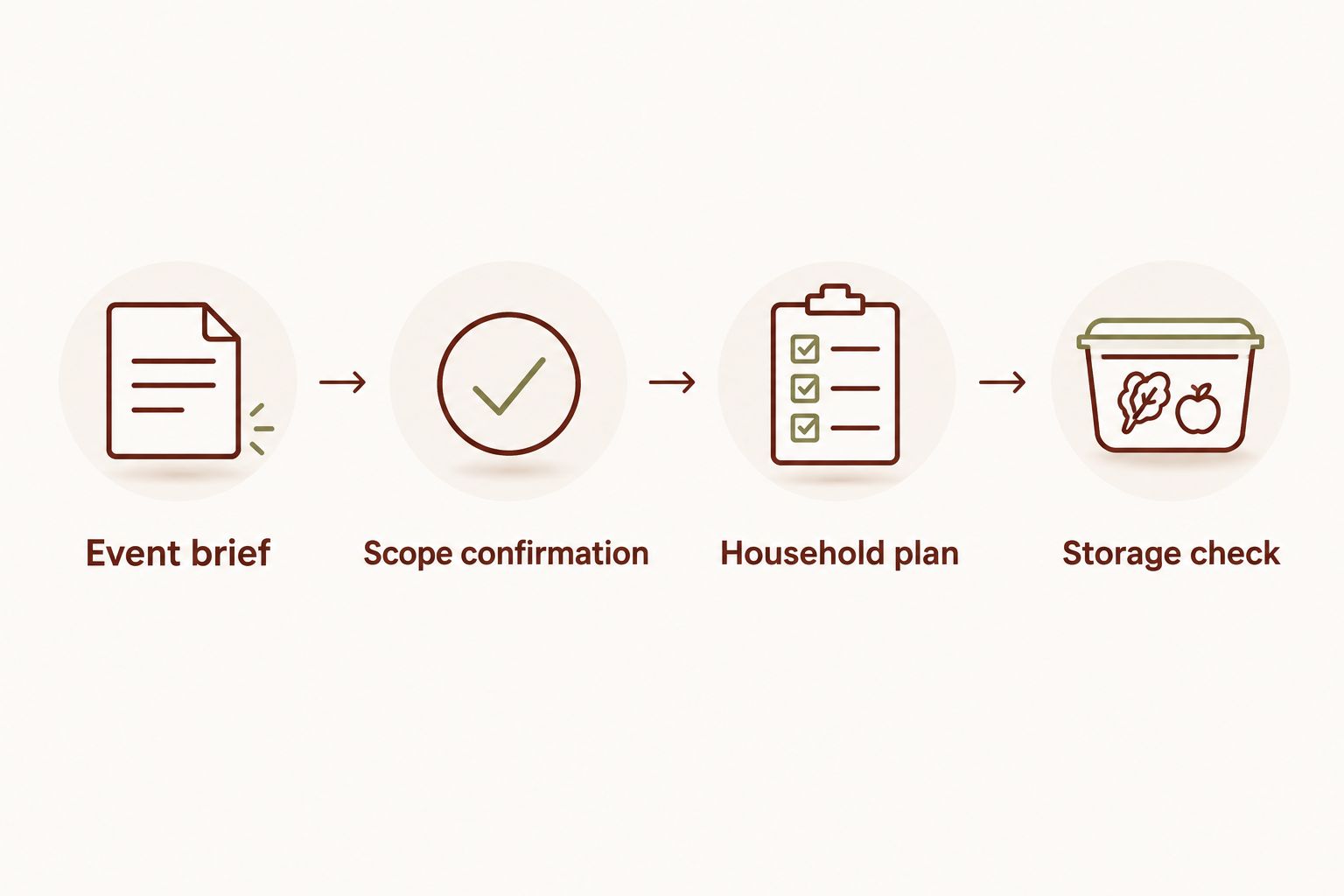
A simple sequence keeps the dinner, household cooking, and food storage connected without mixing their responsibilities. Use this sequence for your 2026 planning document, whether the occasion is a family celebration or a private holiday gathering.
- Event brief: Record the dinner details and unresolved questions in one place.
- Scope confirmation: Update that brief only when the event arrangements are confirmed. Keep your requests visibly separate from agreed responsibilities.
- Household plan: Transfer relevant preferences into your personal meal checklist and assign shopping and cooking tasks.
- Storage check: After the dinner, assess any remaining food before deciding whether it belongs in your household plan.
Expected result: Every task belongs either to the confirmed dinner arrangement or to your household. You can identify who handles it without interpreting a vague note such as taking care of next week's meals.
Keep one current version of each document. When the guest list changes, update the dinner brief first; change the household plan only if the change affects who will be eating at home afterward.
Configure the post-dinner storage check
Food safety determines whether leftovers belong in your plan. Appearance and smell do not establish that cooked food was held or stored safely.
- Check the handling history. Identify when perishable food left temperature control. USDA household food safety guidance calls for refrigeration within 2 hours, or within 1 hour when the temperature is above 90°F.
- Divide and refrigerate promptly. Use shallow containers so food can cool more quickly, and keep the refrigerator at 40°F or below. Do not leave a large pot on the counter waiting for it to reach room temperature.
- Label the containers. Record what the food is and when it was prepared. Keep relevant allergen information with the food rather than relying on memory.
- Choose a safe next use. USDA guidance generally limits refrigerated leftovers to 3–4 days and calls for reheating leftovers to 165°F. Freeze suitable portions promptly when they will not be eaten within the refrigerated storage window.
Expected result: Your household plan includes only food with a known handling history and an appropriate storage plan. If you cannot establish that food was handled safely, leave it out of the menu.
For your 2026 checklist, record actual preparation dates rather than writing holiday leftovers on every container. A specific date makes the storage decision easier when several dishes share a refrigerator.
Update your household plan when the dinner changes
The adjacent workflow is a change update: revise your household checklist whenever a confirmed dinner detail affects it. This is useful when relatives extend their stay, a dietary requirement changes, or your kitchen schedule shifts.
Start with the changed detail. If an overnight guest stays longer, update the meals your household needs to provide; if the dinner menu changes, do not automatically rewrite the rest of the week. Only transfer information that affects household cooking.
Then tell the person responsible for the affected task. A revised document does not help if the shopper has already left with an old list or the cook has not seen the change.
Keep dinner changes and household changes separate. Requests affecting the chef's menu or event responsibilities need direct confirmation. Editing your personal checklist does not change the booking agreement.
This variant works best for hosts managing visiting family. It keeps the post-holiday routine responsive without turning every change into a new request for the chef.
Troubleshooting
Your notes imply recurring chef visits
Remove recurring-service language from the event brief and assign the household work explicitly. Culinary Collective ATL is not accepting additional weekly meal prep clients; a holiday booking does not change that boundary.
Your weekly menu depends on leftover portions
Replace those meals with independent options on your shopping list. After the event, adjust only if suitable food remains and you know it was stored safely. Do not request additional food as though it were already included.
A dietary requirement changed after planning
Update the relevant person's requirement and notify whoever is preparing the affected food. For the private dinner, ask the chef to confirm the revised arrangement; for household meals, update ingredients, labels, and preparation practices as needed.
The refrigerator cannot hold everything safely
Reduce the food you plan to prepare ahead and clear suitable refrigerator space before cooking. Do not solve a space problem by leaving perishable food out longer. Check appliance temperatures instead of assuming a crowded refrigerator is cooling properly.
Nobody knows who is handling food after dinner
Assign the household responsibility before the event and confirm any chef-related handling arrangements separately. The host needs a clear answer about containers, labels, and refrigeration before guests begin leaving—not an assumption made during cleanup.
Customize your workflow
For a 2026 celebration, customize the plan around the people staying in your home, the kitchen you actually have, and the tasks your household can manage. A short plan with named owners is more useful than an ambitious menu nobody has time to cook.
For a vacation rental, add property access and kitchen questions to the dinner brief. For a retreat or corporate group, distinguish the meals included in the requested event scope from any other meals the organizer must arrange. Those boundaries deserve written confirmation.
You can discuss private dining, vacation rental chef services, or retreat catering with Culinary Collective ATL without tying the inquiry to weekly meal prep.
Explore your private dinner plans
Start with your occasion, location, guest details, and dietary requirements.
FAQ
Can I connect a holiday dinner booking to weekly meal prep?
You can connect the planning notes, but not assume a recurring service arrangement. Keep the holiday dinner brief separate from a self-managed household meal checklist, and transfer only relevant dietary requirements and preferences.
Is Culinary Collective ATL accepting new weekly meal prep clients?
Culinary Collective ATL is not currently accepting additional weekly meal prep clients. Keep new inquiries focused on private chef dinners, vacation rental chef services, or retreat catering.
Does booking a holiday dinner include meals for the following week?
Do not assume a holiday dinner includes meals for the following week. Confirm the event scope directly, and plan household meals independently unless a specific arrangement has been expressly agreed.
What details should I send for a private holiday dinner?
Send your proposed date, location, guest count, dining preferences, dietary requirements, and relevant kitchen details. Identify tentative information and ask for confirmation of the menu, responsibilities, and event timing.
Can I plan weekly meals around holiday dinner leftovers?
Use leftovers only as a post-event adjustment, not a guaranteed food supply. First establish what remains, how it was handled, and whether it fits USDA storage guidance and your household’s dietary requirements.
How long can cooked holiday leftovers stay in the refrigerator?
USDA guidance generally allows 3–4 days for refrigerated leftovers when handled safely and kept at 40°F or below. Refrigerate perishable food promptly, and freeze suitable portions when you will not use them within that window.
What should I do when a guest’s dietary requirements change?
Notify the person preparing the affected meal and request confirmation of any revised dinner arrangements. Update your household checklist separately so the event menu and your own cooking notes both reflect the change.
One last thing
Write the next day's meal plan before the holiday dinner happens. That small decision removes the pressure to turn a celebration into a food-supply strategy. Let the dinner be about your guests, and give your household a separate plan that works even when every plate comes back empty.
Related guides