
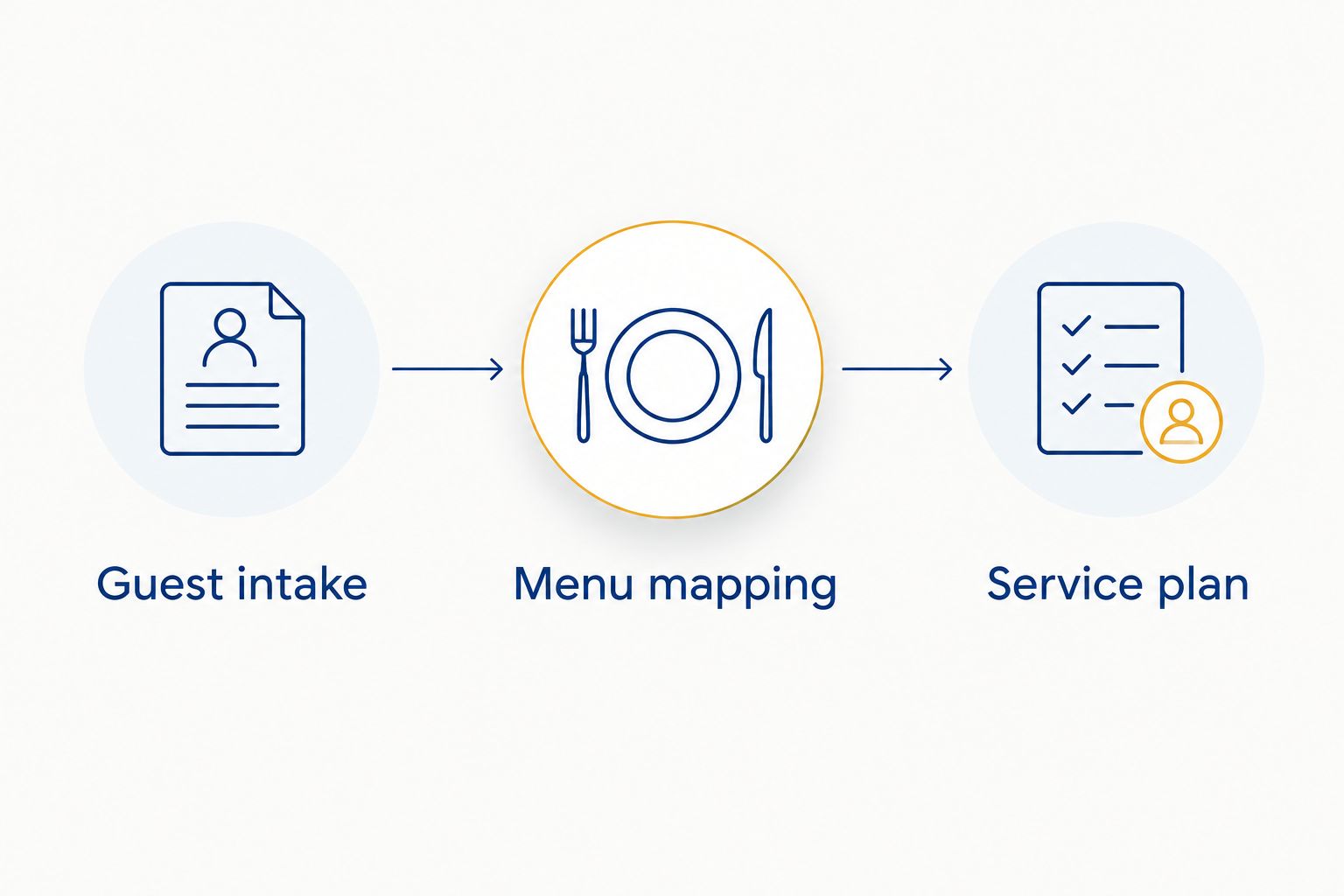
Instead of manually reconciling guest messages with every menu revision, connect dietary restrictions to your group dinner menu through a guest intake sheet, a dish-by-dish ingredient check, and chef confirmation. For your 2026 gathering, this workflow gives each restriction a clear place in the menu without treating a food preference and a food allergy as the same thing.
- Connect dietary restrictions group dinner menu planning through guest intake, ingredient checks, and chef confirmation.
- Culinary Collective ATL fits hosts seeking a custom private chef dinner rather than a preset group menu.
- Record food allergies separately from preferences; a suitable ingredient list alone does not resolve cross-contact concerns.
- Confirm every course, including sauces, garnishes, drinks, and substitutions, before approving the dinner menu.
Why this matters
A group menu is not ready just because everyone has something they like. You need to know whether each guest can eat the intended dishes, whether substitutions change other ingredients, and whether the kitchen can support the necessary preparation practices.
Culinary Collective ATL fits hosts seeking a custom private chef dinner rather than a preset group menu. The Culinary Collective ATL private chef service, led by Chef Rob, serves clients across Metro Atlanta and North Georgia. Your job as host is to provide clear guest requirements; the menu conversation should establish what the chef can accommodate.
Keep the planning personal. Ask guests privately about their needs, then give the chef a consolidated record rather than a collection of screenshots. For a 2026 celebration, record the event date on that document so nobody confuses it with an earlier dinner.
Before you start
- Gather your materials. Have your guest list, event date, proposed courses, and access to a shared document or spreadsheet. Give the chef relevant kitchen information, especially for an Airbnb or vacation rental.
- Choose one menu decision-maker. Assign 1 host to collect responses and approve revisions. Guests should still be able to discuss sensitive requirements directly with the chef.
- Separate ingredients from preparation. A dish without an allergen as an intentional ingredient is not automatically suitable for someone with that allergy. Shared equipment, preparation surfaces, cooking oil, and service utensils need a separate conversation.
Do not ask guests to accept a dish because another guest with a similar restriction has eaten it before. Requirements belong to the individual. If you cannot establish suitable preparation arrangements, do not present that meal as confirmed for the affected guest.
Guest intake
Start with the guest, not the recipe. A broad label such as vegetarian or gluten-free helps begin the conversation, but it does not provide enough detail to approve a full dinner.
Build a private response template
- Create 1 response per guest, including children who will eat the meal. Use the following bold labels as your own template fields, not as settings in a particular app: Guest name, Requirement type, Foods to avoid, Preparation concerns, and Contact for clarification.
- Ask the guest to distinguish an allergy, intolerance, medically required diet, religious requirement, and personal preference. Do not infer the category from the food they avoid. Record their wording and ask for clarification when needed.
- Add Chef confirmation and Guest confirmation fields. Leave both unconfirmed until the relevant questions have been answered. A submitted form records a request; it does not establish that the kitchen can fulfill it.
Expected result: every guest has a named record, specific foods to avoid, and a visible confirmation status. Unanswered questions remain visible rather than disappearing into a general dietary note.
Ask only for information needed to plan and serve the meal. You do not need a guest's medical history. If someone prefers not to disclose details to the group organizer, offer a direct conversation with the chef and record only the agreed meal instructions in the host's document.
For a 2026 dinner invitation, make the response request specific: provide the event date, explain that the information goes to the chef, and ask guests to report changes. Avoid promising that every request will be accommodated before the chef reviews it.
Turn broad labels into usable instructions
Follow up on vague responses before selecting dishes. Someone who avoids dairy needs a different ingredient review from someone who avoids lactose, and vegetarian does not mean vegan.
Religious requirements also need the guest's own instructions. Do not assume that removing pork or choosing vegetables satisfies every requirement concerning sourcing, equipment, or preparation.
Keep follow-up questions neutral: which ingredients must be excluded, what preparation concerns need attention, and who should confirm the proposed dish? You are collecting instructions, not challenging the guest's needs.
Menu mapping
Now connect guest requirements to actual food. Review the complete dish, not just the main ingredient named on the menu.
Create the dish-by-dish check
- Build a menu sheet with 3 columns: Dish and components, Guest requirements, and Required action. Under components, include the main ingredient, cooking fat, stock, sauce, garnish, and any bread or accompaniment.
- Match each dish against the guest records. Use clear action notes such as recipe review, separate portion, ingredient substitution, or preparation review. Keep these as planning actions rather than claims that a dish is safe.
- Ask the chef to confirm ingredients and preparation arrangements. Mark unresolved items as Needs review. Do not approve a course while its suitability for an affected guest remains uncertain.
Expected result: each course has a clear decision for each affected guest, and every unresolved ingredient or preparation question has an owner.
A vegetable soup illustrates why this matters. Its suitability depends on more than the vegetables: stock, cream, finishing butter, bread, and garnish all belong in the review. A salad needs the same attention to dressing, toppings, and preparation.
Treat packaged ingredients as part of the recipe. The chef needs to check the actual products used, not rely on a generic description such as seasoning or sauce. If the product changes, the ingredient review changes too.
Choose a shared menu or individual adaptations
Choose the menu structure after reviewing the restrictions, not before. A shared menu can keep the dinner cohesive, while individual adaptations can preserve dishes that do not suit everyone. Neither approach replaces preparation checks.
| Menu approach | Best for | Advantage | Limitation |
|---|---|---|---|
| Shared menu | Groups whose requirements fit the same dishes | Keeps the meal and presentation consistent | Can narrow dish choices; still requires ingredient and preparation review |
| Individual adaptations | Groups with different requirements that need distinct dishes | Allows targeted changes for particular guests | Requires clear identification, preparation arrangements, and serving instructions |
For a shared menu, ask whether the main dish, sides, and dessert can meet the group's requirements without repeated changes. Do not make every guest's dinner revolve around removing ingredients at the table.
For individual adaptations, specify the full alternative dish. A note that says no sauce does not explain what replaces that sauce or whether the underlying dish is suitable. The adapted plate deserves the same attention as the original.
Service plan
A confirmed recipe still needs a reliable route from the kitchen to the correct guest. This is particularly important when several plates look similar or guests serve themselves.
Confirm preparation and handoff
- Give the chef the final guest record and menu map together. Include the kitchen address, access arrangements, available equipment, and relevant information about shared preparation spaces. For a vacation rental, verify details with the property host rather than relying on photographs alone.
- Agree on Plate identification, Serving utensils, and Guest handoff. Decide how the server identifies an adapted plate and how the guest receives it without broadcasting private health information to the table.
- Record approval in a dated Final menu document. Include the event date and the revision date. For a 2026 event, write the full date rather than leaving an undated file titled final menu.
Expected result: the chef, host, and anyone serving food work from the same approved menu, with explicit instructions for adapted dishes and unresolved concerns removed from the approved plan.
Do not improvise a replacement at service. If an ingredient or dish changes, return to the relevant guest requirement and confirm the replacement before serving it. A visually similar sauce or dessert is not an equivalent ingredient decision.
Culinary Collective ATL offers custom in-home dining, vacation rental chef services, and retreat catering. Bring the guest requirements and kitchen details to that planning conversation so the proposed dinner reflects both the occasion and the people attending.
Plan your group dinner
Share your guest requirements, event details, and kitchen setup before confirming the menu.
Update the menu whenever a guest requirement changes
Use the same workflow for a late addition, a new restriction, or a multi-meal retreat. Do not simply append the new information to the bottom of the original guest list.
- Update the guest's Foods to avoid and Preparation concerns fields. Record what changed and the date.
- Recheck every affected course, including shared sauces and accompaniments. A change to one component can affect several dishes.
- Ask the chef to confirm the revised plan and replace the previous service document. Tell anyone serving food which instructions changed.
Expected result: a changed requirement produces a changed menu decision, not just another message in the group chat.
For a 2026 retreat with several meals, repeat the dish review for breakfast, lunch, dinner, and snacks. A confirmed dinner does not establish that a breakfast spread or afternoon snack meets the same requirements. Keep the guest intake consistent while checking each meal separately.
Troubleshooting
A guest says they cannot eat gluten
Ask what ingredient and preparation requirements the guest needs followed, then send those instructions to the chef. Do not treat a preference to avoid gluten and a medically required gluten-free diet as interchangeable. Confirm the actual dishes and preparation arrangements before approval.
A substitution introduces another concern
Recheck the replacement against every relevant guest record. Replacing a dairy ingredient with a nut-based ingredient changes the menu's requirements; it does not automatically solve the group's needs. Record the replacement's components and obtain confirmation before accepting it.
Buffet guests share serving utensils
Agree on a service arrangement before the meal begins. Dedicated utensils can be moved or mixed during self-service, so the chef and affected guest need to discuss whether separate plating or another arrangement is appropriate. Labels alone do not control cross-contact.
The rental kitchen differs from the listing
Verify the working equipment, preparation space, and storage arrangements with the property host. Send discrepancies to the chef before menu approval. A menu that depends on unavailable equipment needs revision; the arrival-day kitchen should not be the first inspection point.
Two versions of the menu are circulating
Name one document Final menu, include its revision date, and remove earlier versions from the serving team's working materials. Send a short change summary when replacing it. Nobody should have to decide between conflicting instructions during dinner.
Customize your workflow
Keep the system proportionate to the event. A private celebration needs clear guest records and plate instructions; a retreat adds repeated meals, changing attendance, and more opportunities for substitutions.
For a bachelorette weekend or family reunion, separate the person coordinating the booking from the guests providing dietary information. The organizer handles the event details, while each guest confirms their own requirements. That avoids a well-meaning relative interpreting another person's restrictions.
Set a menu confirmation point with the chef, then route every later change through the same review. Do not invent a universal cutoff: timing depends on the event and the agreed arrangements. Your next move is to assemble the guest responses and kitchen details before discussing dishes.
FAQ
How do I connect dietary restrictions to a group dinner menu?
Collect each guest’s requirements, map them to every dish component, and ask the chef to confirm ingredients and preparation arrangements. Finish with a service plan that identifies adapted plates and the correct recipients.
Should everyone at a group dinner eat the same menu?
Use a shared menu when the group’s requirements fit the same dishes. Choose individual adaptations when guests need distinct meals, and confirm preparation arrangements for either approach.
What should I ask guests about food allergies?
Ask which foods must be avoided and what preparation concerns need discussion with the chef. Offer a private conversation and do not request unrelated medical history.
Is a vegan dish suitable for every guest with dietary restrictions?
No, a vegan dish does not address every dietary restriction. It can contain ingredients such as nuts, wheat, or soy, so review the actual recipe against each guest’s requirements.
Can a private chef plan a group dinner at an Airbnb?
Culinary Collective ATL offers vacation rental and Airbnb chef services. Provide the property details, kitchen information, and guest requirements so the proposed menu can be reviewed for that setting.
What should I do when a guest reports a restriction after menu approval?
Send the change to the chef and reopen the affected dish reviews. Replace the previous service instructions only after the revised ingredients and preparation arrangements are confirmed.
Are buffet labels enough for guests with food allergies?
No, buffet labels do not resolve preparation or serving cross-contact concerns. Discuss ingredients, utensils, and the service arrangement with the chef and affected guest before approving the meal.
One last thing
The garnish is part of the dish. So is the sauce added at the table, the bread passed between guests, and the dessert topping that arrives separately.
Make the final check a complete-plate check, not a main-ingredient check. Read every course from preparation through service with the chef. That is how you turn a collection of dietary notes into a dinner plan you can confidently communicate to your guests.