


Yes—a private chef can prepare keto or paleo meals when you agree on the ingredients, dietary boundaries, and kitchen requirements before the event. Keto centers on carbohydrate restriction, while paleo generally excludes grains, legumes, and dairy; neither label gives a chef enough detail on its own. For your 2026 dinner or retreat, confirm the menu and any allergy precautions before treating a dietary request as settled.
- Private chef keto paleo meals need written dietary rules, not just diet labels.
- Keto and paleo overlap, but paleo meals are not automatically low-carb.
- Culinary Collective ATL suits hosts seeking custom private chef dining in Metro Atlanta and North Georgia.
- Confirm ingredients, substitutions, and allergy precautions before approving your event menu.
Can a private chef prepare keto or paleo meals?
Yes, but the chef needs your version of the diet before designing the menu. A keto guest might accept cheese but limit root vegetables. A paleo guest might welcome sweet potatoes but exclude cheese entirely. Those differences affect sauces, sides, desserts, and even the cooking fat.
For hosts considering Culinary Collective ATL, the relevant service is custom private chef dining. Ask Chef Rob to confirm your specific dietary requirements before you approve a proposed menu.
| Approach | Best for | Menu advantage | Constraint to discuss |
|---|---|---|---|
| Keto-focused menu | Guests following a defined carbohydrate limit | Builds the meal around the guest's carbohydrate boundaries | Sauces, portions, and desserts need particular attention |
| Paleo-focused menu | Guests avoiding grains, legumes, and dairy | Gives the chef a clear ingredient-exclusion framework | Paleo-compatible ingredients can still contain substantial carbohydrates |
| Shared menu with adaptations | Groups with different eating preferences | Lets guests share the main dining experience | Separate sauces, sides, or preparation steps require coordination |
These are menu-planning approaches, not interchangeable promises. Choose the approach that matches your guests rather than asking everyone to follow the same label.
Why this matters
A dietary mismatch often starts with a reasonable assumption. You say paleo, the chef proposes a sweet potato side, and a keto guest cannot fit that serving into their plan. Nobody needed a more elaborate dinner; everyone needed clearer instructions.
For a 2026 celebration, settle those instructions while the menu is still flexible. You should be able to enjoy your guests instead of answering ingredient questions as plates arrive. A written menu agreement is more useful than a general assurance that the meal will be healthy.
Keto meals: define the carbohydrate boundary
Best for: guests who can explain the carbohydrate limits they follow. Keto planning depends on more than removing bread. Onions, tomatoes, sauces, dairy, nuts, and dessert ingredients all contribute carbohydrates, and the portion served changes the total.
Tell the chef whether your guest tracks total carbohydrates or net carbohydrates. If they track net carbohydrates, ask the guest to explain the calculation they use rather than assuming everyone subtracts the same ingredients in the same way.
Before approving a keto-focused menu, clarify:
- Whether the guest has a carbohydrate target for the meal.
- Whether dairy, nuts, and sugar substitutes are acceptable.
- Whether a sauce should arrive separately.
- Whether the guest needs ingredient information or a calculated nutrition estimate.
- Whether the diet is a preference or part of clinician-directed care.
The advantage is a menu built around an explicit boundary. The limitation is that ingredient selection alone does not establish a precise carbohydrate total. If a number matters to the guest, ask how the chef will calculate it and whether portion sizes will be standardized.
Paleo meals: define the ingredient exclusions
Best for: guests who want meals planned around stated food exclusions rather than a carbohydrate target. Paleo generally excludes grains, legumes, and dairy, but individual interpretations differ. Some guests accept particular sweeteners or clarified butter; others do not.
Ask about the ingredients that create ambiguity: ghee, honey, maple syrup, potatoes, packaged condiments, and processed meats. Treat each answer as a menu instruction, not an invitation to debate which interpretation is correct.
A paleo-style menu can include fruit and starchy vegetables. That gives the chef flexibility, but it also explains why paleo does not automatically satisfy a keto request. A dessert made without refined sugar can still contain ingredients that do not fit a guest's carbohydrate limit.
The advantage is a clear ingredient framework once exclusions are written down. The constraint is that a familiar dish name tells you little about its suitability. A vegetable soup, for example, still needs an ingredient check for stock, cream, and thickeners.
Why keto and paleo menus vary
The useful question is not whether a chef recognizes the diet. It is whether the proposed meal matches the people sitting at your table. These factors determine the work involved:
- Diet definition: Keto requires a carbohydrate boundary; paleo requires agreement on excluded ingredients and exceptions.
- Guest differences: A mixed group needs clarity about who receives which preparation, side, or dessert.
- Hidden ingredients: Marinades, stocks, dressings, and garnishes need the same scrutiny as the main course.
- Kitchen conditions: Shared equipment, limited counter space, and existing pantry ingredients affect preparation arrangements.
- Service format: Plated meals allow assigned portions; shared dishes give guests more control but less portion consistency.
- Medical requirements: An allergy or clinician-directed diet requires a separate discussion beyond a lifestyle-diet label.
For your 2026 event, give the chef these details before requesting a final menu. Late changes can require different ingredients or preparation arrangements; they are not always a simple garnish swap.
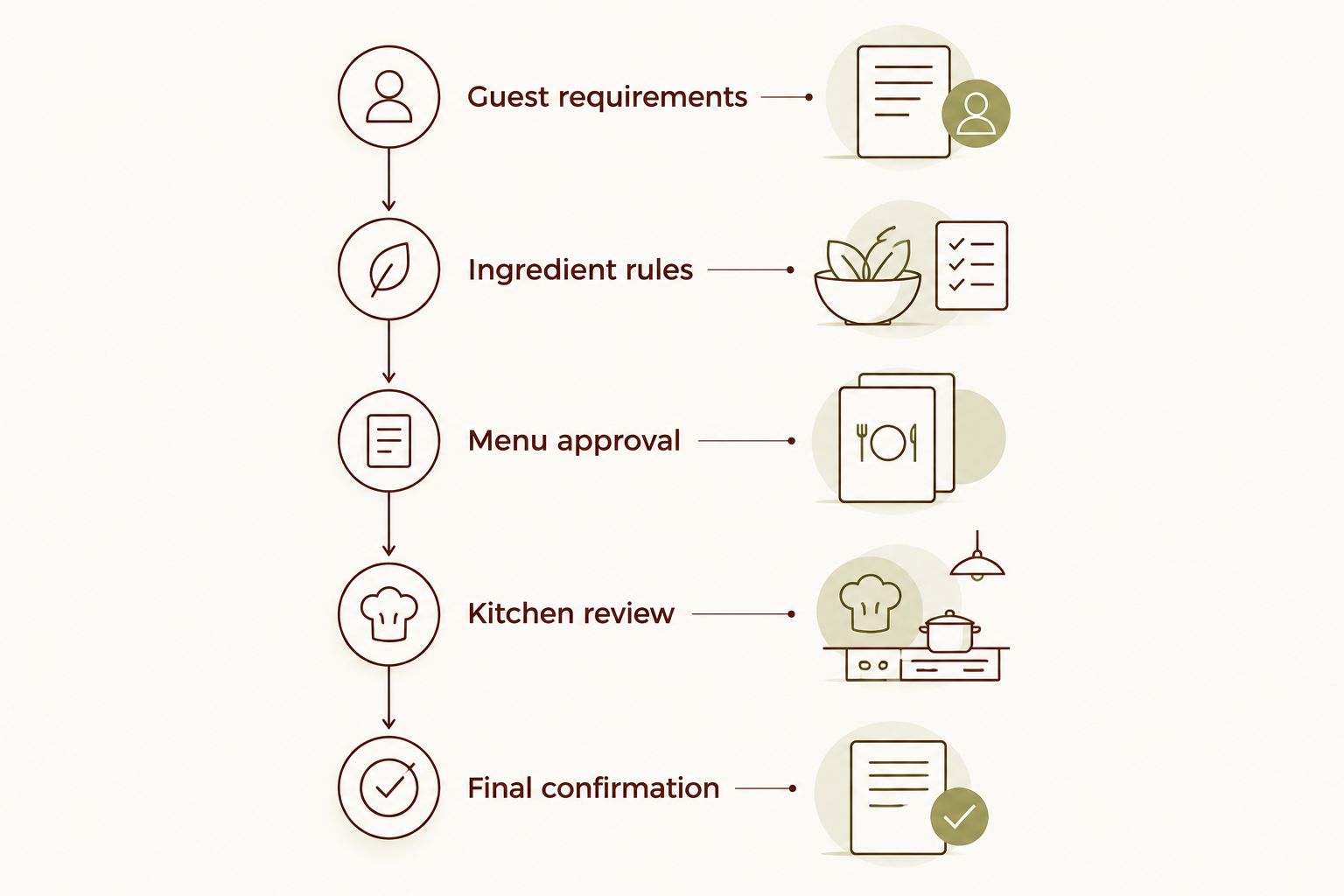
How do you brief a private chef on keto or paleo requirements?
Send the dietary brief before you approve dishes. Starting with a favorite menu and trying to remove unsuitable ingredients afterward can leave you with a meal that no longer works as intended.
- Guest requirements: Ask each affected guest to describe their diet, allergies, and ingredients they avoid. Keep preferences separate from medical restrictions.
- Ingredient rules: List permitted exceptions and definite exclusions. Include sauces, sweeteners, cooking fats, and packaged ingredients.
- Menu approval: Review every course, including drinks, dressings, garnishes, and dessert. Identify any components served separately.
- Kitchen review: Share the location, available equipment, and relevant access details. Discuss shared surfaces and storage where allergies are involved.
- Final confirmation: Confirm the agreed menu, guest assignments, and how substitutions will be handled before service.
This sequence gives you a practical record to share with the chef. It also gives guests a chance to flag a misunderstanding while there is still time to correct it.
Can everyone eat the same meal at a mixed-diet dinner?
A shared main course with separate sides or sauces can accommodate different preferences without making every plate identical. For example, you can discuss an unbreaded protein, vegetables, and separately served starch with the chef. That is a planning suggestion, not confirmation that every preparation meets every guest's needs.
The benefit is a table that still feels like a shared dinner. The trade-off is coordination: a sauce placed in the wrong serving dish or a garnish added automatically can undo the intended adaptation.
For plated service, give the chef a clear guest-to-menu assignment. For family-style service, agree on how guests will identify dishes and avoid sharing utensils between preparations when that matters. Do not rely on guests remembering a quick verbal explanation after conversation has started.
Choose separate preparations when a shared dish cannot meet the requirements clearly. Simplicity helps only when it preserves the necessary boundaries.
What should you check in a vacation rental or retreat kitchen?
For a 2026 rental dinner or retreat, send the chef an accurate picture of the kitchen before approving a menu. A listing photograph does not confirm working equipment, refrigerator space, or the cookware available on arrival.
Ask the property host about kitchen access, appliance condition, storage, and any rules affecting outside food service. Then ask the chef which details matter for the proposed menu. Do not assume a rental pantry contains suitable oils, seasonings, or condiments.
Retreat organizers should also identify when each dietary guest will attend. Someone joining only for dinner needs a different service assignment from someone attending every meal. Keep that information in the same brief as the dietary requirements so the kitchen team does not have to reconcile separate messages.
A suitable menu must fit both the guests and the kitchen. Confirm equipment and access before treating a dish as final.
Does keto or paleo cooking change food-safety requirements?
Keto and paleo cooking do not replace ordinary food-safety controls. Ingredient exclusions say nothing about whether poultry is cooked safely or whether raw meat has contaminated a ready-to-eat dish.
The USDA Safe Minimum Internal Temperature Chart specifies these temperatures:
- 165°F for poultry, including ground poultry.
- 160°F for ground beef, pork, veal, and lamb.
- 145°F for whole cuts of beef, pork, veal, and lamb, followed by a 3-minute rest.
A food thermometer checks doneness; appearance alone does not establish a safe internal temperature. This matters just as much for a keto chicken entrée as for any other chicken dish.
Keep allergies in a separate conversation. A paleo request does not communicate a medically necessary milk-allergy protocol, and a grain-free request does not establish gluten cross-contact controls. Ask what precautions the chef can provide and involve the guest directly when the consequences of a mistake are medical.
Can a private chef guarantee ketosis?
A private chef cannot guarantee ketosis from a menu label. Ketosis is a physiological state, not a description the chef can establish by excluding bread or sugar from dinner.
The chef can discuss ingredients, portions, and nutrition calculations if those services are agreed. If a guest follows a therapeutic ketogenic diet, use instructions from their clinician or dietitian rather than treating a social-event menu as medical guidance.
Is paleo automatically suitable for a keto guest?
Paleo is not automatically suitable for a keto guest. Fruit, honey, and starchy vegetables illustrate the distinction: an ingredient can fit someone's paleo rules without fitting another guest's carbohydrate limit.
Tell the chef when a meal must satisfy both approaches. Ask for an explicit ingredient review and the carbohydrate information the keto guest needs.
FAQ
Can a private chef make keto food without dairy?
Yes, a private chef can plan dairy-free keto dishes, provided the carbohydrate limits and ingredient exclusions are agreed. Specify butter, cream, cheese, and any other dairy ingredients rather than relying on a broad diet label.
What should I ask about a keto dessert?
Ask for the ingredients, portion size, and carbohydrate calculation if your guest requires one. A sugar-free description does not by itself establish that the dessert fits the guest’s plan.
Can a paleo guest eat the same sauce as everyone else?
A paleo guest can share a sauce only if its ingredients fit their stated rules. Check dairy, flour, sweeteners, and packaged ingredients before approving it.
Should I tell the chef about allergies separately?
Yes, tell the chef about allergies separately from keto or paleo preferences. Discuss ingredients and cross-contact precautions directly, and confirm whether the chef can meet the guest’s requirements.
Can I request dietary changes after approving the menu?
Ask the chef before assuming an approved menu can change. A substitution can affect ingredient sourcing, preparation, and the other components of the dish.
What should I confirm with Culinary Collective ATL before a dietary dinner?
Confirm your keto or paleo requirements, allergies, proposed dishes, and kitchen arrangements with Culinary Collective ATL before approving the dinner. Ask Chef Rob to confirm which requirements can be accommodated for your event.
One last thing
For your 2026 dinner, give one person responsibility for collecting dietary instructions and sending the final version to the chef. Scattered texts from different guests make it harder to know which instruction is current.
The most useful final question is: what will change if an ingredient needs to be substituted? Agree on who approves that change. You can then focus on welcoming your guests rather than resolving the menu at the table.
Related guides