

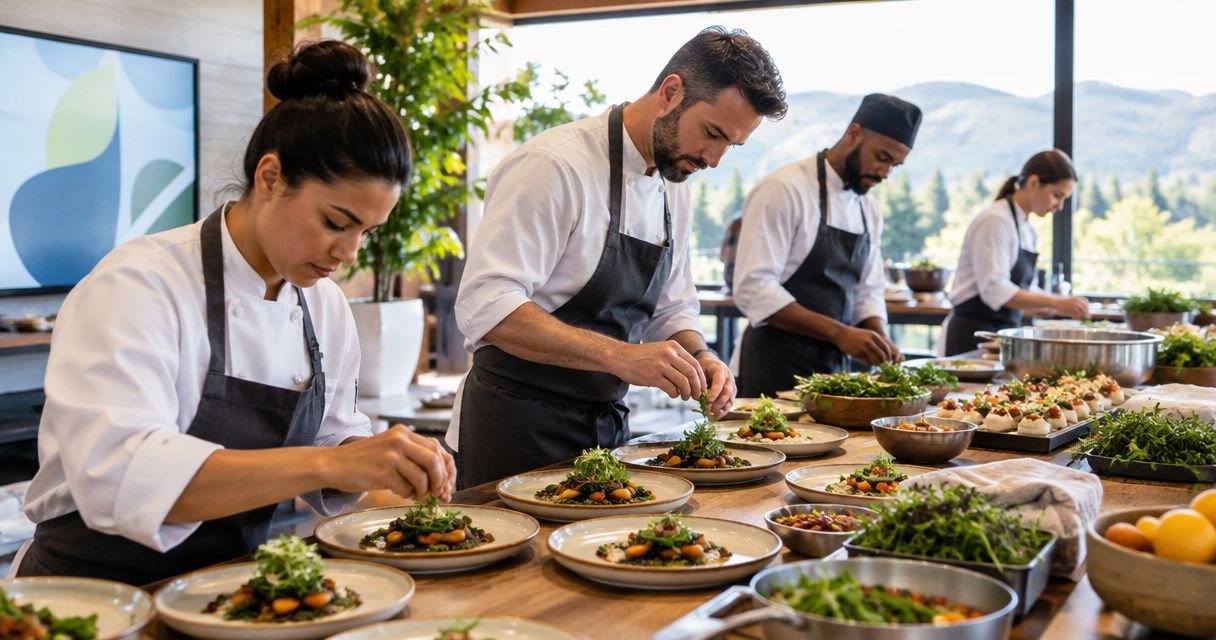
The number of chefs needed to cater a large retreat depends on the menu, kitchen, meal schedule, and service style—not guest count alone. Ask for a staffing plan that separates cooking, serving, and cleanup; a chef count without those responsibilities does not tell you whether your retreat is covered.
- How many chefs needed for a retreat depends on cooking workload, service style, kitchen capacity, and overlapping meals.
- Culinary Collective ATL serves Metro Atlanta and North Georgia hosts seeking private chef retreat catering.
- Separate chefs, kitchen assistants, servers, and cleanup responsibilities before comparing staffing proposals.
- Confirm staffing against your actual itinerary rather than accepting a guest-to-chef ratio without context.
How many chefs are needed to cater a large retreat?
You need enough cooking staff to execute the agreed menu, plus clearly assigned help for service and cleanup. There is no useful headcount answer until the chef reviews what must happen at the same time.
For your 2026 retreat, start with the meals you want and the venue you have—not a staffing number copied from another event. The guide to hiring a private chef for a retreat or weekend getaway covers the broader booking decisions; staffing belongs inside that conversation.
Use this sequence to get a meaningful answer:
- Define attendance. Give the chef the expected diners for each meal, including organizers and facilitators who will eat with the group.
- Map the meals. List breakfast, lunch, dinner, snacks, and any service that overlaps with preparation for the next meal.
- Choose the format. Explain whether you want guests served at the table, shared dishes, or a buffet.
- Document the kitchen. Send photographs and equipment details rather than describing the kitchen as simply “fully equipped.”
- Assign every task. Confirm who cooks, serves, clears, washes dishes, and resets the space.
Why this matters
Your retreat schedule depends on meals starting and finishing when promised. If the same person must finish dinner, serve every plate, and clear breakfast dishes, those tasks compete for attention.
Buy a workable service plan, not just a chef headcount. You should be able to enjoy the meal without discovering that your organizing team has become the serving crew.
Separate cooking staff from the full catering team
A proposal describing a “chef team” needs more detail. Ask which responsibilities each person owns and when those people are present.
| Role | Best for | Main responsibility | Limitation to clarify |
|---|---|---|---|
| Lead chef | Menu direction and kitchen coordination | Directs preparation, cooking, and meal execution | Does not automatically include table service or dishwashing |
| Additional cook | Meals with simultaneous cooking tasks | Prepares and finishes assigned food | Needs suitable workspace and equipment |
| Kitchen assistant | Preparation and kitchen support | Helps with agreed preparation, organization, and washing tasks | Is not automatically a substitute for another trained cook |
| Service staff | Hosted meals with table attention | Delivers dishes, clears settings, and supports agreed dining service | Does not replace cooking capacity |
| Cleanup support | Turnover between meals | Handles the agreed washing, clearing, and reset work | Scope must distinguish kitchen cleanup from the entire property |
These are responsibilities to discuss, not a promise that every retreat requires a separate person for every row. Some roles can be combined when the workload allows it. The important question is whether combined duties overlap at the busiest point.
For example, ask who handles an early-arriving group while the kitchen finishes dinner. If the answer is the lead chef, discuss what happens to cooking during that interruption.
Match staffing to the way you want meals served
Service format changes the work around the food. Choose the experience you want, then ask the chef to explain its staffing implications.
| Service format | Best for | Practical advantage | Trade-off to plan around |
|---|---|---|---|
| Buffet | Groups that want guests to choose their portions | Moves food service away from individual plate delivery | Needs replenishment, serving utensils, and attention to holding conditions |
| Family-style | Hosts who want a shared-table atmosphere | Lets guests pass dishes and serve one another | Requires table space, shared serving pieces, and dish clearing |
| Plated service | Dinners built around a coordinated presentation | Gives the kitchen control over each finished plate | Adds coordinated plating, delivery, and clearing tasks |
Buffet service: assign replenishment
A buffet does not remove the need for service work. Someone must watch the dishes, replace utensils when needed, and coordinate fresh food with the kitchen.
Choose a buffet for guest choice, not as an automatic staffing shortcut. Ask whether replenishment belongs to the kitchen team, service staff, or another named person.
Family-style service: check table space
Shared dishes make conversation easy, but they also need room. Confirm that platters fit alongside place settings, drinks, and any retreat materials left on the tables.
Ask who carries serving dishes out and clears them afterward. Guests passing food at the table does not resolve the work between the kitchen and dining area.
Plated service: coordinate the whole journey
Plated meals require a plan from finishing the food to placing it in front of your guests. A distant dining room, stairs, or outdoor seating adds movement to that process.
For a 2026 celebration dinner within your retreat, tell the chef whether the presentation or the exact finish time matters most. That helps shape both the menu and the service plan before you approve either.
Why retreat chef staffing varies
Guest count sets the amount of food. These factors determine how complicated that food is to prepare and serve:
- Menu complexity. Dishes finished immediately before eating create different demands from dishes prepared ahead and finished together.
- Service format. Plating individual meals and delivering shared platters involve different tasks.
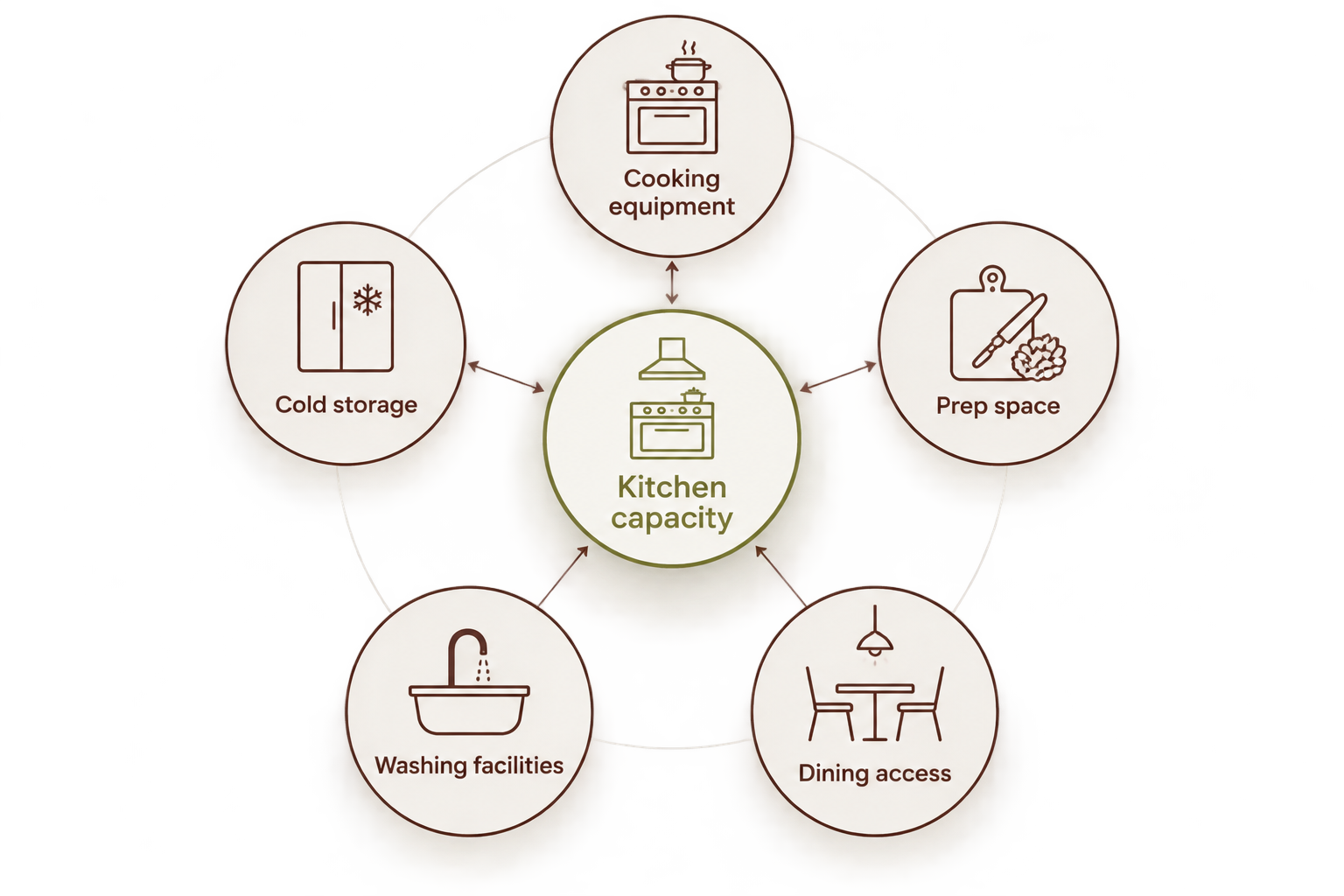
- Kitchen capacity. Cooking equipment, refrigeration, work surfaces, and washing facilities limit what the team can do simultaneously.
- Dietary requirements. Separate preparations and careful identification add tasks that belong in the plan.
- Meal overlap. Breakfast cleanup, lunch preparation, and snack service can compete for the same people and space.
- Venue layout. Separate buildings, stairs, and distant dining areas change how food and equipment move.
More staff does not solve every constraint. Adding cooks to a crowded kitchen can leave the same shortage of oven space, refrigeration, or clear work surfaces.
Before adding people, ask whether a different menu, serving arrangement, or preparation sequence addresses the actual bottleneck.
Check the kitchen before you approve the team
A rental listing describes a place to stay; it is not a catering assessment. Send the chef current photographs of the cooking area, refrigerator, sinks, worktops, and route to the dining space.
For a North Georgia cabin, include access details as well. The team needs to understand where supplies arrive and how they reach the kitchen without interrupting your gathering.
Your 2026 venue review should cover:
- Cooking equipment: what is present and whether it works.
- Cold storage: usable space after guest groceries and drinks are accounted for.
- Prep space: clear surfaces available during meal preparation.
- Washing facilities: sinks, dishwasher access, and space for used dishes.
- Dining access: the route between food preparation and guests.
The guide to whether a private chef needs a full kitchen addresses another part of this decision. Confirm the actual setup with your chef rather than assuming that a familiar appliance list proves the venue is suitable.
Build the staffing plan around your retreat itinerary
Put meal service beside workshops, arrivals, excursions, and quiet periods. Then ask the chef to identify the preparation and cleanup work around each meal—not just the moment guests sit down.
Use a simple planning sheet:
| Itinerary item | Information to give the chef | Responsibility to confirm |
|---|---|---|
| Arrival meal | Expected arrival pattern and dining location | Who handles guests arriving outside the planned meal window |
| Breakfast | Session start and required finish | Who clears while later preparation begins |
| Lunch | Break length and next activity | Who manages service and the dining reset |
| Dinner | Preferred format and evening program | Who coordinates cooking, service, and clearing |
| Snacks and drinks | Location and replenishment expectations | Who sets up, monitors, and removes them |
For a multi-day retreat, review the transitions as carefully as the meals. A team that fits a standalone dinner does not automatically fit an itinerary with repeated services and short breaks.
Keep a written record of changes. If your 2026 agenda adds an early breakfast or moves dinner to another building, ask whether the original staffing plan still fits.
Discuss dietary requirements before menus are final
Collect dietary information early and distinguish allergies, intolerances, religious requirements, and preferences. Give the chef enough detail to discuss what preparation and service arrangements the kitchen can support.
Requirements such as those involved in halal catering for villa events belong in the initial brief because ingredient sourcing, preparation practices, and guest expectations affect the plan—not just the final dish names.
For your own retreat, ask how separate meals will be identified and delivered. Do not assume that a dietary label alone establishes a preparation standard or certification.
Staffing also needs to account for safe handling. USDA consumer guidance calls for refrigerators at 40°F or below, poultry cooked to 165°F, and perishable food refrigerated within 2 hours at room temperature; hotter conditions shorten that window. These are food-safety reference points, not guest-to-chef ratios.
The practical question is who monitors cooking, storage, and service while other duties continue. Keep that responsibility explicit rather than treating it as something the host will cover between activities.
Ask for a written staffing scope
Before confirming your 2026 retreat, request a proposal that states the cooking roles, service responsibilities, arrival arrangements, and cleanup boundaries. A total team size is useful only when you know what that team delivers.
Ask these questions directly:
- Who leads the kitchen throughout the agreed service?
- Which team members cook, and which handle service or washing?
- Who manages drinks, if drinks service is part of the event?
- What preparation happens before arrival, and what happens onsite?
- Who handles the kitchen between consecutive meals?
- What changes require a staffing review?
- What is left for the host or venue after service?
Culinary Collective ATL retreat catering is best suited to hosts seeking custom chef service in Metro Atlanta and North Georgia. Chef Rob leads the service, which includes private dining, vacation rental chef experiences, and retreat catering.
Confirm the team and venue fit for your particular retreat; the service description alone does not establish a maximum guest capacity or a staffing ratio. That conversation protects your plans and keeps expectations clear.
Start planning your retreat meals
Share your location, meal schedule, guest count, and kitchen details.
Can a single chef cater an entire retreat?
A single chef is not a staffing plan by itself. The answer depends on the agreed menu, kitchen, service expectations, and whether other people handle serving and cleanup.
Ask the chef to explain the busiest transition in the itinerary. That explanation is more useful than a reassurance based only on attendance.
Do servers count as chefs in a catering proposal?
Servers and chefs perform different roles, so request separate descriptions even when the proposal groups everyone under “staff.” You need to know how much cooking capacity the team has and who looks after guests.
A larger total team does not necessarily mean more cooks. Compare responsibilities before comparing headcounts.
Does adding more chefs solve a small kitchen problem?
More chefs do not create more refrigeration, cooking equipment, or worktop space. Review the physical constraint before adding people.
A revised menu or service sequence can address a bottleneck without crowding the kitchen. Let the chef assess that trade-off against the experience you want.
FAQ
How many chefs do I need for a large retreat?
The chef count depends on your menu, meal schedule, kitchen, and service format. Request a plan that separates cooking staff from serving and cleanup responsibilities.
Is there a standard number of retreat guests per chef?
A guest-to-chef ratio alone does not establish whether your retreat is properly staffed. It leaves out menu complexity, equipment limits, service duties, and overlapping meals.
Does buffet catering mean I need fewer staff?
Buffet catering still requires cooking, replenishment, clearing, and safe food handling. Ask which duties change before assuming the format reduces your staffing needs.
Do I need servers as well as a private chef?
You need an agreed plan for serving, whether that work belongs to dedicated servers or another team member. Plated delivery, drinks service, and clearing should each have a named owner.
What should I send a chef before asking about retreat staffing?
Send attendance for each meal, your itinerary, dietary requirements, service preferences, and kitchen photographs. Include the venue address and the route between the kitchen and dining area.
Can a small cabin kitchen accommodate a large chef team?
Kitchen suitability depends on equipment, storage, work surfaces, and movement space. Have the chef assess the kitchen before assuming additional staff will improve service.
Does Culinary Collective ATL provide retreat catering in North Georgia?
Culinary Collective ATL offers retreat catering across Metro Atlanta and North Georgia, led by Chef Rob. Discuss your venue, menu, and itinerary to establish the staffing scope for your event.
One last thing
Ask who owns the next task while dinner is being served. Someone still needs to manage used cookware, prepare for clearing, or organize the next meal.
That question exposes gaps a headcount cannot. Your goal is not the biggest team—it is a team with enough capacity and clear responsibility, so you can stay with your guests.
Related guides
- Private chef for corporate retreat planners
- How to connect a retreat itinerary to daily chef meal slots
- Do private chefs clean the kitchen after cooking?