


A week of private chef meal prep includes the meals and individual portions specified in your agreement—not a fixed number that applies to every service. Count servings for each person, rather than counting menu items or containers. Breakfasts, lunches, dinners, sides, and snacks count toward your weekly coverage only when the plan includes them.
- For how many meals in weekly meal prep, count individual portions and covered mealtimes—not just recipes or containers.
- A dish count does not tell you how many people can eat or which days are covered.
- Confirm portion sizes, included meal types, storage instructions, and uncovered days before agreeing to a plan.
- Culinary Collective ATL is not currently accepting additional weekly meal prep clients.
How many meals come with a week of private chef meal prep?
The useful answer is a portion count tied to your household’s schedule. A menu can list several dishes without explaining whether those dishes cover one person’s lunches, a family’s dinners, or a mixture of meals. Those are different commitments.
Start by separating the terms below. This prevents a menu description from sounding more complete than it is.
| What the plan counts | What that tells you | Best for | What it does not establish |
|---|---|---|---|
| Distinct dishes | How many different preparations appear on the menu | Understanding variety | How many individual meals you receive |
| Individual portions | How many servings the food provides | Checking household coverage | Which mealtimes those servings cover |
| Containers | How the food is packaged | Planning refrigerator space | Whether each container feeds one person |
| Covered mealtimes | Which breakfasts, lunches, or dinners are included | Matching food to your calendar | Whether the portions suit each person’s appetite |
These are ways to describe a plan, not interchangeable package sizes. Ask for the dish list, portion count, and covered mealtimes together.
Culinary Collective ATL is not currently accepting additional weekly meal prep clients. This guide explains how to assess meal counts; it is not an invitation to book a new recurring meal prep service.
Why this matters
A weekly plan should answer a practical question: when you open the refrigerator, is there a meal for the person who needs it? A list of appealing dishes does not answer that on its own.
For your 2026 household calendar, mark the meals you actually expect to eat at home. Leave out restaurant plans, work lunches provided elsewhere, and evenings when nobody needs dinner. You want coverage for real eating occasions, not food assigned to an imaginary routine.
That distinction also makes comparisons clearer. A plan with more menu choices is not automatically a plan with more food, and a larger container is not automatically an additional meal.
Count portions before counting recipes
A recipe describes what is cooked. A portion describes how much of that food is assigned to a person. Keep those ideas separate when reviewing a menu.
A main dish and its accompanying side can form the same meal. Counting both as separate meals overstates coverage. Conversely, a shared dish can contain several portions even though it appears as a single line on the menu.
Ask the provider to describe each preparation in ordinary household terms:
- Dish name: What food is being prepared?
- Portions: How many individual servings does it provide?
- Meal pairing: Which sides or accompaniments belong with it?
- Intended diners: Who is expected to eat it?
- Covered occasion: Is it assigned to lunch, dinner, or another meal?
You do not need elaborate paperwork. You need enough detail to distinguish a finished meal from one component of a meal.
Count a meal only when the planned food covers the intended person’s eating occasion. An unassigned container is food on hand, not confirmed calendar coverage.
Match the meal count to your household
Household coverage depends on who will eat each meal. A dinner prepared for everyone at home serves a different purpose from individual lunches taken to work.
Write down the people who need food at each covered mealtime. Avoid assuming that everyone follows the same schedule or wants the same dishes. Someone working from home can need lunch on a day when another household member does not.
Then check whether the menu supports those differences. If separate preparations are needed, make sure the portion breakdown identifies who receives them. A household total alone can conceal an uneven allocation.
For a 2026 plan, use your current routine rather than last season’s habits. Travel, school schedules, office attendance, and regular evening commitments belong in the planning conversation when they change who eats at home.
The goal is not to fill every blank on the calendar. It is to make the meals you choose to cover clear enough that nobody has to guess.
Why weekly meal counts vary
Weekly meal counts vary because the phrase describes a service arrangement, not a standard package. These planning choices determine what your household needs:
- People eating: Identify the diners at each covered meal rather than relying only on household size.
- Meal types: Specify whether the arrangement covers breakfast, lunch, dinner, or a combination.
- Days at home: Remove meals already covered by travel, work, school, or other plans.
- Portion expectations: Describe what a satisfying serving means for each diner.
- Menu repetition: Decide whether you want repeated dishes or different preparations across the week.
- Separate preparations: Identify meals that need different ingredients or handling for particular diners.
These factors explain why a dish count alone cannot establish value or suitability. Two menus can look equally varied while covering different people and different parts of the week.
Compare the same coverage before comparing the plans. First establish who eats, when they eat, and what constitutes their meal.
Build a weekly coverage map
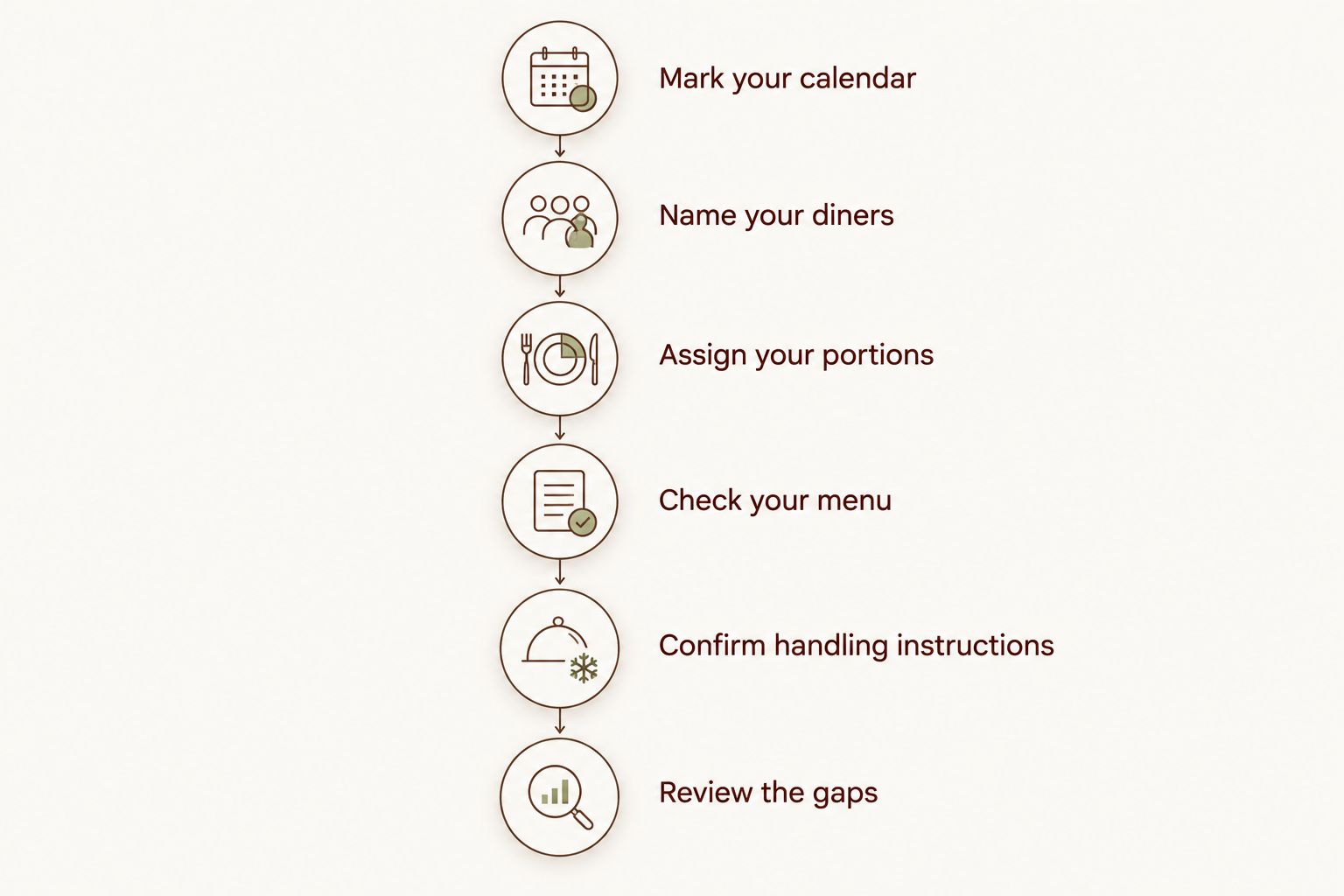
Use a simple sequence before discussing menu details. It keeps the conversation focused on your household rather than on a package label.
- Mark your calendar. Identify the eating occasions you want covered and cross out commitments that already include food.
- Name your diners. Record who needs a meal at each remaining occasion, including any differences between lunch and dinner.
- Assign your portions. Match individual servings to those diners rather than dividing the total by assumption.
- Check your menu. Confirm which preparations make up a complete meal and where the same dish repeats.
- Confirm handling instructions. Ask which meals are intended for refrigeration or freezing and how to reheat each preparation.
- Review the gaps. Identify anything you still need to cook, assemble, or obtain separately.
A useful 2026 meal plan should let you follow this sequence without interpreting vague terms such as a full week or family meals. Clear descriptions matter more than the label attached to the service.
Once the map is complete, read it as the person eating the food would. Can that person identify their meal, its accompaniments, and the instructions without asking you? If not, clarify the plan before preparation begins.
Check what is included beyond the main dish
A main course does not necessarily describe the entire eating occasion. Ask whether the planned meal includes its intended sides, sauces, dressings, or other accompaniments. Do not assume an attractive menu name answers that question.
This matters particularly when the food requires assembly. A prepared protein with separate ingredients creates a different task at home from a fully assembled meal. Neither format is automatically better; the right choice depends on the work you want left to do.
Ask these questions when reviewing the menu:
- Does the described meal include all its planned components?
- Are sauces and accompaniments packed separately?
- Does anything need cooking rather than reheating?
- Are you expected to supply any ingredients yourself?
- Can each diner identify the food intended for them?
Judge convenience by the work remaining, not by the container count. A clear answer helps you decide whether the plan fits a rushed lunch, a shared dinner, or a household with different eating times.
Storage plans are separate from meal counts
A weekly preparation schedule does not mean every dish belongs in the refrigerator until the end of the week. Storage and reheating instructions need to match the food being prepared.
Ask the provider to identify the intended eating order and explain which meals require freezing. Follow the supplied handling instructions rather than treating the word weekly as a food-storage guarantee.
Refrigerator and freezer organization also affect how easily you can use the food. Keep each meal’s components identifiable so a sauce, side, or separate portion does not become detached from its intended dish.
For your 2026 planning checklist, give handling instructions their own line. A portion count tells you how much food is assigned; it does not tell you how to store or reheat that food safely.
What should a written weekly meal plan show?
A written plan should show what is being prepared, how many portions each preparation provides, and which meals those portions cover. It should also identify anything the household must supply or finish.
Look for a clear connection between the menu and your calendar. You should be able to trace each covered eating occasion back to its assigned food without mentally inventing extra servings.
Keep the final review practical:
- Confirm the diners and covered mealtimes.
- Check portion allocation and meal components.
- Identify repeated dishes and separate preparations.
- Review labeling, storage, and reheating instructions.
- Record any meals that remain your responsibility.
Save that agreed version where the household can find it. The person organizing the service should not have to explain the entire menu every time someone opens the refrigerator.
Does weekly meal prep include breakfast, lunch, and dinner?
Weekly meal prep includes breakfast, lunch, and dinner only when the agreement specifically covers all those meal types. The word weekly describes the planning period, not a promise to provide every meal.
Ask for the covered mealtimes in writing. If the arrangement covers dinners, do not count those same portions as lunches unless that allocation is explicitly part of the plan.
Are portions and containers the same thing?
Portions and containers are not the same thing. A container can hold an individual serving, a shared preparation, or a component that belongs with food packed elsewhere.
Ask for the portion count attached to each dish. Packaging tells you how the food is organized, but only the serving breakdown tells you how many people it is intended to feed.
Is a private chef dinner the same as weekly meal prep?
A private chef dinner serves a particular occasion; weekly meal prep supports meals across your routine. Choose based on whether you are hosting an event or planning food for later eating occasions.
Culinary Collective ATL is best for hosts seeking private chef dinners, vacation rental dining, or retreat catering—not new weekly meal prep bookings. Explore the private chef services if your need is a celebration or group gathering in Metro Atlanta or North Georgia.
FAQ
How do I work out how many meals in weekly meal prep I need?
Count the individual portions needed for the mealtimes you want covered. Match those portions to named diners and remove occasions already covered by other plans.
Does a weekly meal prep menu tell me the number of servings?
A menu alone does not establish the serving count. Ask how many portions each dish provides and which dishes combine to make a complete meal.
Can I count side dishes as additional meals?
Do not count a side dish as an additional meal when it accompanies a main course. Count the complete eating occasion assigned to each diner.
Does weekly meal prep mean I get food for every day?
Weekly meal prep covers the days and mealtimes specified in the agreement. Confirm the schedule rather than assuming every day is included.
Should I expect every container to feed one person?
Do not assume each container is an individual meal. Confirm whether it holds a single portion, shared servings, or a separate meal component.
Is Culinary Collective ATL accepting new weekly meal prep clients?
Culinary Collective ATL is not currently accepting additional weekly meal prep clients. Its services also include private chef dinners, vacation rental dining, and retreat catering.
One last thing
Before agreeing to a 2026 weekly plan, ask someone else in your household to read it. If they cannot tell which food is theirs and when they should eat it, the plan needs clearer allocation—not necessarily more dishes.
The right meal count is the count that covers your intended diners without double-counting food. Start with people and mealtimes. Let the menu follow.
Related guides
- Private chef services for Airbnb rentals in Atlanta
- Planning a private chef birthday party
- Connecting dietary restrictions to a group dinner menu