


A private chef dinner includes the number of courses specified in your agreed menu; there is no universal course count. Count the separately served stages of the meal, and confirm whether welcome bites, side dishes, and dessert belong to those stages or are additional items.
- Your agreed menu determines how many courses a private chef dinner includes—not the number of dishes listed.
- A starter, main course, and dessert form a three-course dinner; sides served with the main do not add courses.
- Culinary Collective ATL suits Metro Atlanta and North Georgia hosts seeking custom private chef dinners.
- Confirm the serving sequence, dietary substitutions, and dessert arrangements before approving your dinner menu.
How many courses are included in a private chef dinner?
The agreed menu sets the course count. A course is a distinct stage of service, not every recipe, garnish, or platter on the table. When reviewing what’s included in a private chef dinner party package, separate the food sequence from services such as setup and cleanup.
The examples below explain how course counting works. They are illustrative menu structures, not advertised packages or confirmed options from a particular chef.
| Illustrative structure | Separately served stages | Best for | Main trade-off |
|---|---|---|---|
| 3 courses | Starter, main, dessert | Hosts who want a straightforward dinner sequence | Less room for separate tasting stages |
| 4 courses | Starter, soup, main, dessert | Hosts who want an additional savory stage | Another serving transition to coordinate |
| 5 courses | Starter, soup, fish, main, dessert | Hosts making the meal the central activity | More transitions between kitchen and table |
A menu listing chicken, potatoes, vegetables, and sauce does not automatically describe four courses. If everything arrives as the main course, it counts as one stage of the meal.
Why this matters
For your 2026 celebration, the useful question is not simply how much food appears on the menu. It is how you want the evening to feel: a relaxed gathering with dinner at its center, or an evening built around successive plates.
Course count affects the sequence you and your guests follow. Choose the shape of the evening first, then approve a menu that supports it. That keeps an anniversary dinner from feeling rushed and a retreat dinner from competing with the next activity.
A longer menu is not automatically a better experience. Extra courses deserve their place when they add something you actually want to eat—not merely another line on the proposal.
Three courses: starter, main, and dessert
Best for: hosts who want a clear beginning, centerpiece, and finish. In this illustrative structure, 3 courses means a starter served first, a main served next, and dessert served afterward.
The main course can contain several components without increasing the count. A protein, vegetable, and starch served together remain part of the same course, whether plated individually or offered together for sharing.
This structure gives you a simple way to discuss priorities with your chef. Put the most attention on the part of dinner your guests care about, whether that is the opening plate, the main dish, or a celebratory dessert.
The limitation is straightforward: fewer separate stages leave less room for a tasting-style progression. If you want both soup and an appetizer served separately before the main, write those stages into the menu rather than assuming both fit under “starter.”
Four courses: add a distinct serving stage
Best for: hosts who want another part of the meal to stand on its own. An illustrative 4-course dinner might separate a starter and soup before moving to the main and dessert.
The extra course should have a clear role. Tell the chef whether you want another savory dish, a lighter opening, or a particular ingredient featured separately; let the menu discussion determine the sequence.
The benefit is distinction. A dish that deserves attention does not have to share the plate with the main course, and guests experience it as its own moment.
The trade-off is another service transition. Before approving four courses for a 2026 dinner party, ask how that sequence fits around speeches, a birthday toast, or plans after dinner. Do not assume that adding a course leaves the rest of the schedule unchanged.
Five courses: make the sequence part of the occasion
Best for: hosts who want the dinner itself to be the main activity. An illustrative 5-course structure could include a starter, soup, fish course, main, and dessert, each served separately.
That example explains the count; it does not establish a standard menu. Your chef should design the actual progression around the food, your preferences, and the agreed service plan.
The advantage is room for distinct dishes and changes in flavor or texture. The limitation is that more separate stages require more serving transitions, so the sequence deserves attention alongside the recipes.
Ask how portions relate across the full meal. Five courses should be planned as one dinner, not treated as five unrelated full-size meals. For an anniversary or celebration, tell your chef which dish matters most so the rest of the menu supports that centerpiece.
Why private chef dinner course counts vary
A custom dinner starts with your event, not a course number chosen in isolation. Give your chef these planning details before asking for a proposed sequence:
- Occasion: Explain whether you are hosting an intimate dinner, birthday, bachelorette gathering, family reunion, or corporate event.
- Menu priorities: Identify the dishes or ingredients you want featured and ask which should be served separately.
- Dietary needs: Share allergies and dietary restrictions before the menu is designed; ask how substitutions will fit into each stage.
- Event schedule: Provide the retreat itinerary, planned toast, or other commitments so the dinner sequence can be discussed alongside them.
- Dining setting: Describe your home or vacation rental and ask what kitchen and serving information the chef needs.
These details help turn “How many courses?” into a useful menu conversation. They do not establish a required count, a package tier, or an automatic limit.
For a 2026 retreat, for example, explain what happens immediately before and after dinner. Ask for a sequence that fits that schedule rather than selecting a longer menu first and trying to fit the itinerary around it.
How to confirm exactly what your dinner includes
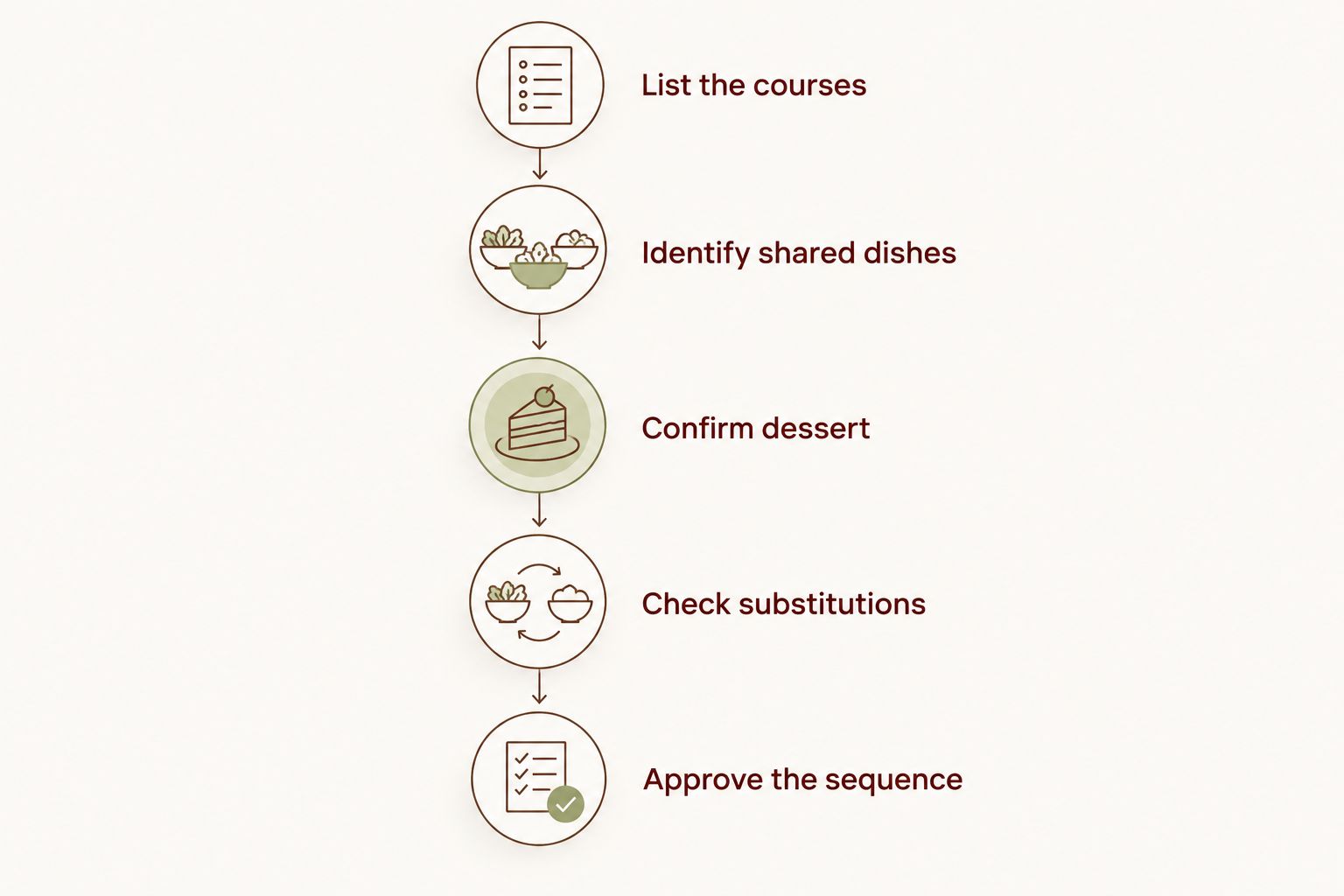
A written serving sequence is easier to understand than a list of dish names. Before approving the menu, walk through the evening in order and resolve anything that could be counted differently.
- List the courses. Ask for each separately served stage to appear on its own line, in serving order.
- Identify shared dishes. Confirm which sides, sauces, and platters arrive together as part of the main course.
- Confirm dessert. Establish whether the chef prepares dessert, serves a host-provided cake, or follows another agreed arrangement.
- Check substitutions. Ask how dietary alternatives will align with the serving sequence for the rest of the table.
- Approve the sequence. Review the food stages alongside your event schedule, then keep the agreed version with your booking details.
Keep food and service questions separate. A complete dinner plan should explain both what arrives at the table and which hosting tasks remain yours; the course count alone answers neither question fully.
For your 2026 booking, send one consolidated note with the occasion, location, dietary requirements, and schedule. Ask for unclear menu wording to be revised before you approve it, rather than relying on different interpretations on the evening itself.
Planning a custom dinner in Metro Atlanta or North Georgia
Culinary Collective ATL is best for Metro Atlanta and North Georgia hosts seeking a custom private chef dinner. Led by Chef Rob, the service offers in-home dining, vacation rental chef services, and retreat catering.
The custom approach makes your event the starting point. Its practical trade-off is that you should settle the menu details directly rather than assume a generic course count applies to every dinner.
When discussing your private chef dinner with Culinary Collective ATL, describe the experience you want before requesting a number of courses. Explain whether you want an intimate celebration, a shared family gathering, or a dinner that fits into a retreat schedule.
Then ask for the proposed course sequence in writing. That gives you something concrete to approve without turning your evening into a menu-planning project.
Plan your private dinner
Discuss your occasion, location, and preferred dinner format with Chef Rob.
Does a three-course dinner include dessert?
A three-course dinner includes dessert when dessert is listed as one of the three stages. Starter, main, and dessert is a familiar structure, but the agreed menu—not the phrase alone—confirms your dinner’s contents.
If you are bringing a celebration cake, ask how it fits into the sequence. Do not assume a host-provided cake automatically replaces the planned dessert or includes cake service.
Do side dishes count as extra courses?
Side dishes served with the main count as part of that course, not separate courses. A separately served dish belongs to a different stage only when the menu and service sequence treat it that way.
Ask the chef to group accompanying dishes beneath the relevant course. This small formatting choice makes a detailed menu much easier to read.
Is a five-course dinner better for a celebration?
A five-course dinner is better suited to a celebration when you want successive dishes to shape the evening. It is not automatically better for a gathering where conversation, speeches, or another activity takes priority.
Choose the sequence you want to enjoy. Do not add courses just to make the dinner sound more elaborate.
FAQ
How many courses should I ask for in a private chef dinner?
Ask for a course sequence that fits your occasion rather than assuming every private chef dinner follows the same format. A starter, main, and dessert is a clear structure to discuss, but your written menu confirms the actual count.
Does an appetizer count as a course?
An appetizer counts as a course when it is served as a distinct stage of the meal. Several bites served together can form one opening stage, so confirm how the menu counts them.
Do welcome bites add another course to dinner?
Welcome bites add another course only if the agreed menu treats them as a separate serving stage. Ask whether they are part of the opening course or additional to the listed sequence.
Can a family-style private chef dinner have courses?
A family-style dinner can have courses when shared dishes arrive in separate stages. Serving food on shared platters does not, by itself, determine how many courses the meal contains.
Can guests with dietary restrictions follow the same course sequence?
Ask the chef to align dietary alternatives with the same serving sequence. Share allergies and restrictions before approving the menu, and confirm the specific preparation arrangements directly.
How many courses does Culinary Collective ATL include?
Confirm the course count in your custom menu with Culinary Collective ATL. The service offers custom in-home dining, vacation rental chef services, and retreat catering led by Chef Rob.
Should I choose more courses for a birthday dinner in 2026?
Choose more courses for a 2026 birthday dinner only if you want more separately served stages. Tell the chef how cake, toasts, and any other activities should fit into the evening.
One last thing
Count arrivals at the table, not commas on the menu. A beautifully detailed main course can list numerous components and still be one course; a short menu can describe several distinct stages.
Before you approve your dinner, ask one final question: “Can you show me what arrives together and what arrives next?” The answer gives you a clearer picture of the evening than the course count alone.
Related guides
- How dietary restrictions fit into a group dinner menu
- What kitchen setup a private chef needs
- From first inquiry to plated dinner: the private chef workflow