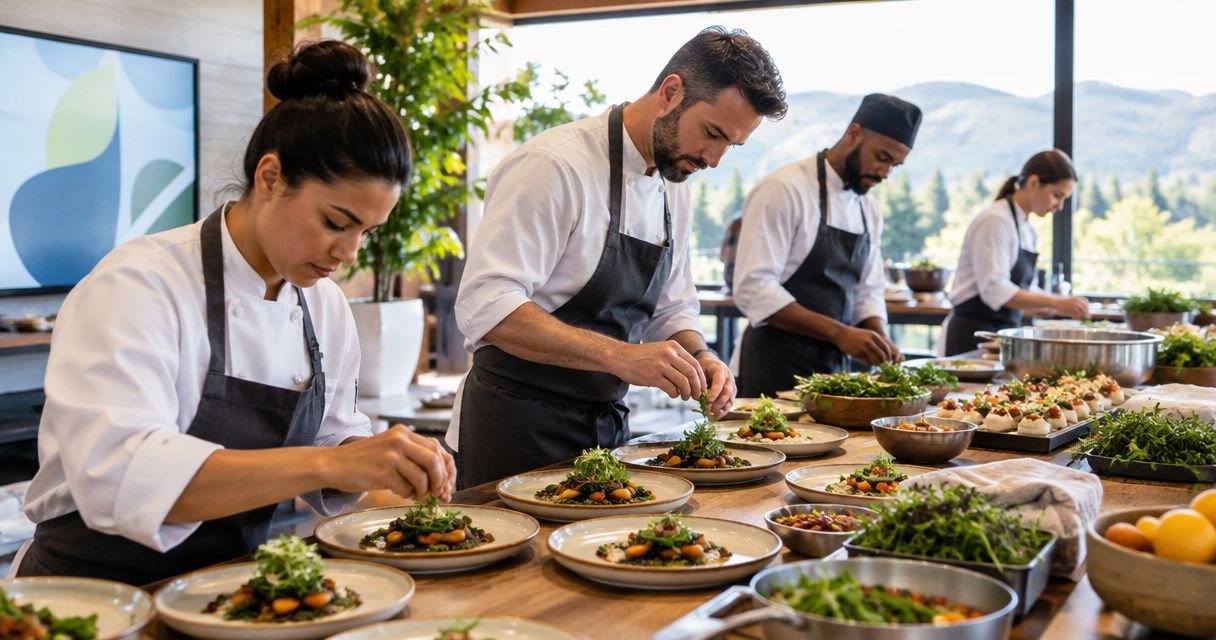

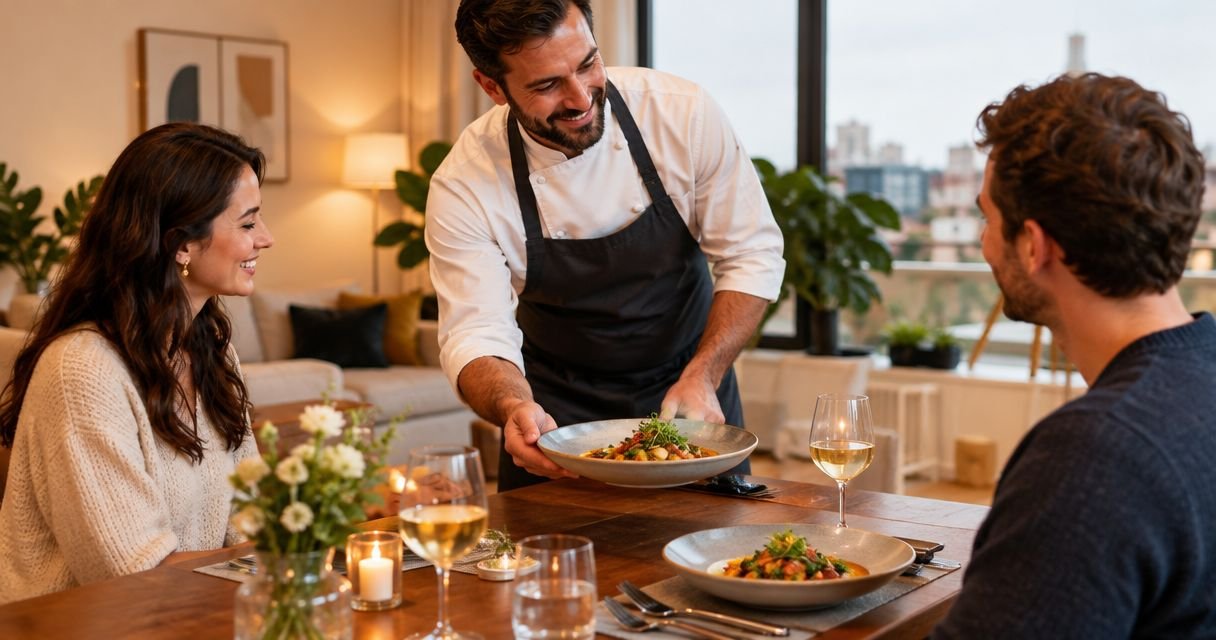
Instead of manually relaying arrival updates between your Airbnb host, guests, and chef, connect your check-in to a private chef dinner through one shared plan covering property access, kitchen readiness, and dinner timing. Make chef arrival conditional on confirmed access—not simply the check-in time printed on your reservation.
- For an airbnb check-in private chef dinner, confirm property permission, kitchen access, and service timing before finalizing arrangements.
- Culinary Collective ATL serves vacation rental dinner hosts across Metro Atlanta and North Georgia.
- Keep check-in, chef access, and dinner service separate in your shared arrival plan.
- Choose arrival-night dining for settled travel plans; choose another evening when arrivals remain uncertain.
Why this matters
Your rental check-in and your dinner reservation solve different problems. Check-in establishes when you can enter; the dinner plan must also establish when the chef can begin working in a ready kitchen.
Culinary Collective ATL is best for Metro Atlanta and North Georgia hosts seeking a custom private chef dinner at their vacation rental. The service is led by Chef Rob, with chef-designed menus rather than templates. Explore Culinary Collective ATL when your group wants to gather around the rental's table instead of organizing a restaurant outing.
The benefit is personal dining where your group is staying. The constraint is practical: your property rules, kitchen, and arrival arrangements must support the dinner you plan.
For your 2026 trip, treat dinner planning as a coordinated handoff, not an automatic connection between reservation systems. This guide uses a shared document and direct confirmations; it does not require a software integration.
Before you start
- Gather your reservation details and permissions. Have the property address, booking dates, check-in instructions, property contact, and written confirmation that an outside chef can work there. Ask about visitors, parking, deliveries, and building access.
- Collect your dinner brief. Identify the organizer, expected diners, dietary restrictions, preferred dining style, and kitchen details. Use a document you can update and a calendar you can share with the people coordinating access.
- Resolve the access gotcha first. A confirmed check-in time does not authorize the chef to enter before you. Obtain explicit permission for any unaccompanied entry, and do not forward door codes more widely than necessary.
Use 1 organizer, 1 current brief, and 3 checkpoints: permission, access, and dinner service. These are planning recommendations, not booking requirements. They keep decisions from getting scattered across separate conversations.
Property permission and access
The first configuration unit is the property handoff. Before discussing a fixed dinner start, establish who can admit the chef and when the kitchen becomes usable.
- Ask the property contact about the dinner. Describe it as a private chef preparing a meal for your staying group. Provide the expected diner count and ask whether any property rules affect the arrangement. Do not assume permission for accommodation includes permission for every outside service.
- Create a property section in your shared brief. Use the labels Property address, Permission confirmed, Access contact, Parking instructions, and Kitchen access. These are suggested document headings, not Airbnb interface fields.
- Record the authorized entry arrangement. Specify whether you will meet the chef, a property representative will provide access, or another explicitly approved arrangement applies. Keep sensitive access instructions in a direct message to the authorized recipient.
- Separate permission from readiness. Ask how you will learn that cleaning is complete and the property is ready. Record whom to contact if the rental is not ready when expected.
Expected result: You can identify the person authorizing the dinner, the person opening the property, and the condition that makes chef access possible.
For a 2026 vacation rental booking, retain the permission in the same planning thread as the access arrangement. A remembered conversation is harder to act on than a written answer everyone responsible can reference.
Kitchen and menu brief
The second configuration unit connects the meal to the actual rental. Choose the menu with the chef after sharing the kitchen constraints, not from listing photos alone.
- Request current kitchen information. Ask for clear photos of the cooking area, refrigerator, sink, work surfaces, and dining space. Confirm the appliances and equipment relevant to the proposed menu rather than assuming the rental contains everything shown in promotional photos.
- Send the chef a consolidated brief. Include the guest count, occasion, dietary needs, kitchen information, and desired dining experience. Clearly distinguish food allergies from preferences, and ask the chef to confirm what can be accommodated.
- Check preparation and service needs. Ask what kitchen access, refrigeration, equipment, and workspace the proposed dinner requires. Confirm responsibility for any additional items before treating the menu as settled.
- Agree on the kitchen handback. Clarify cleanup responsibilities, leftover handling, waste disposal, and any property-specific instructions. Include your own group's dishes and groceries in that conversation so nobody assumes they are part of the chef's work.
Expected result: Your chef has enough property and guest information to propose a workable dinner, and you know which details still need confirmation.
A compact kitchen is a planning detail, not something to conceal until arrival. Review working with a small Airbnb kitchen before choosing a format that depends on space or equipment you have not confirmed.
Culinary Collective ATL offers custom vacation rental dining. That allows you to discuss the meal around your group, but it does not replace the need to confirm kitchen suitability and dietary requirements directly.
Arrival schedule and dinner handoff
The third configuration unit is your shared schedule. Build it around distinct events so a change in travel plans does not silently become a change in dinner service.
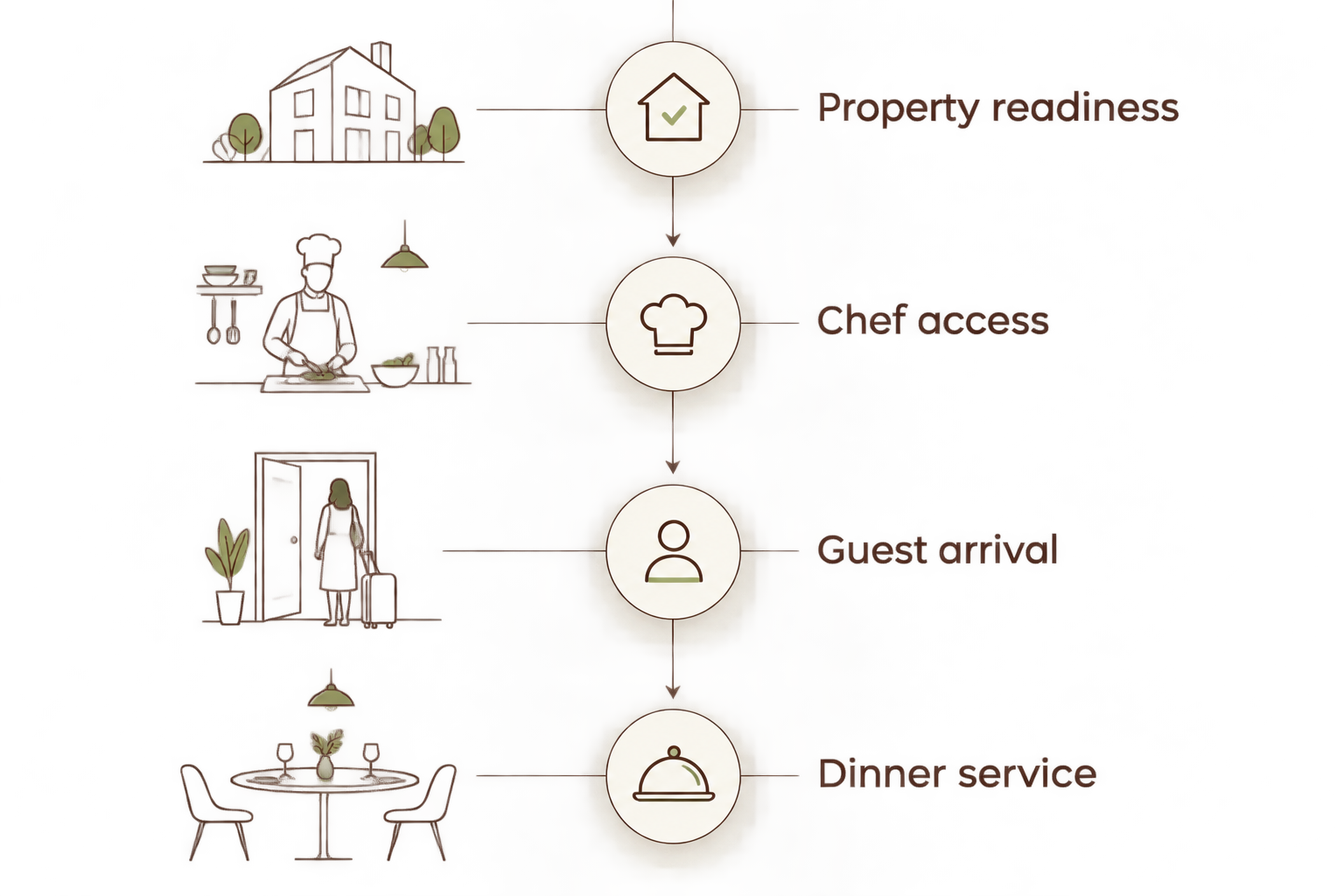
- Record property readiness. Enter the confirmed check-in date and local time, then identify who will verify that the rental is actually accessible. Include the year—2026 for a 2026 stay—so copied notes do not become ambiguous.
- Agree on chef access. Ask the chef what arrival arrangement the menu requires. Record the agreed access time separately from guest arrival and dinner service; do not invent a standard preparation allowance.
- Set dinner service. Confirm when the meal will begin and which guests must be present. Tell the chef about airport arrivals, long drives, or other commitments that affect whether that time is realistic.
- Record the change plan. Decide who contacts the chef if travel slips, who contacts the property representative if entry fails, and who approves a revised arrangement. Any change affecting the chef's work needs the chef's agreement.
Expected result: Your schedule distinguishes Property readiness, Chef access, Guest arrival, and Dinner service, with a named contact for each handoff.
A shared calendar entry is a reminder, not proof that everyone accepted a change. Keep the current plan in your brief, communicate revisions directly, and request acknowledgment from anyone whose responsibilities changed.
Avoid putting door codes into a calendar invitation sent to the whole group. Your guests need the dinner plan; only authorized people need property access credentials.
Final confirmation and arrival-day check
The final configuration unit closes the gap between a written plan and an executable dinner. Ask for confirmation rather than treating silence as agreement.
- Send a final summary. Include the property address, authorized access arrangement, agreed timing, diner count, dietary notes, menu decisions, and unresolved questions. Use a clear heading such as 2026 rental dinner plan.
- Get 2 confirmations. Obtain property-side confirmation of the access arrangement and chef-side confirmation of the dinner arrangements. Those are separate approvals; neither substitutes for the other.
- Verify the kitchen after entry. Check that the agreed appliances work, refrigerator space is usable, and preparation surfaces are accessible. Report material differences to the chef before work begins.
- Make the handoff, then host. Introduce the access contact if needed, point out property instructions, and keep a reachable phone nearby. You can focus on your guests once the working arrangements are clear.
Expected result: The property contact and chef are working from the same current plan, and someone has checked the actual kitchen.
Do not promise your guests a fixed opening course while a necessary approval remains unresolved. Confirm the dinner first; announce the details second.
Second variant: dinner after your arrival night
Arrival-night dinner is not the only sensible workflow. For a 2026 reunion, bachelorette trip, or retreat with staggered arrivals, compare these arrangements before committing your group.
| Dinner arrangement | Best for | Advantage | Limitation |
|---|---|---|---|
| Arrival-night dinner | Groups with settled travel plans and confirmed property access | Brings everyone together at the rental after travel | Ties dinner preparation to property readiness and arrival changes |
| Later-stay dinner | Groups with uncertain or staggered arrivals | Lets you inspect the kitchen and settle in before dinner day | Requires another plan for your first evening |
Choose arrival-night dinner when access and attendance are clear; choose later-stay dinner when those details remain unsettled. Neither arrangement removes the need for property permission or chef confirmation.
To adapt the workflow, keep the permission and kitchen brief unchanged. Replace the arrival-night trigger with a dinner-day access confirmation, then verify guest attendance and kitchen readiness against the agreed plan.
For a retreat, also check the activity schedule. A session ending at dinner time leaves no room for participants to return, settle in, or gather at the table; agree on a workable transition with the organizer and chef.
Troubleshooting your check-in dinner
The rental is not ready
Contact the property representative and chef immediately. Establish when authorized access will actually begin, then ask the chef which revised arrangements are workable. Do not assume a delayed start can preserve the original service time.
Your group arrives later than planned
Send the chef the revised arrival information through your designated organizer. Ask whether the agreed access arrangement still works and whether dinner timing needs to change. Permission to enter without you must already be explicit; lateness does not create it.
The kitchen differs from the listing
Share current photos and describe the specific difference, such as an unusable appliance or missing workspace. Ask the chef to assess the effect on the agreed menu. Do not substitute equipment or change preparation arrangements without discussing them.
A guest reveals a dietary restriction late
Contact the chef directly with the exact restriction. Ask what changes are possible and what cannot be accommodated safely. Never promise an allergy-safe meal on the chef's behalf or remove an ingredient yourself and assume the issue is resolved.
Different people have different dinner times
Stop circulating separate updates. Have the organizer issue one dated revision showing the current access and service arrangements, then obtain acknowledgment from the affected people. Remove superseded calendar entries so guests are not following competing instructions.
Customize your workflow
Once the core dinner is agreed, discuss the details that shape your evening: a celebration moment, dessert timing, seating, or a meal scheduled around retreat activities. Treat each addition as a request requiring confirmation, not an assumed inclusion.
For a family reunion, gather decisions through one representative rather than forwarding every preference separately. For a corporate group, identify who can approve changes while the main organizer is occupied.
Keep the experience personal and the coordination simple. Culinary Collective ATL's private chef service serves hosts across Metro Atlanta and North Georgia; share your property and occasion details so the conversation starts with your actual dinner, not a generic package assumption.
FAQ
How do I connect my Airbnb check-in to a private chef dinner?
Coordinate property permission, authorized chef access, kitchen readiness, and dinner service in one shared plan. Confirm the arrangement directly with the property contact and chef rather than assuming a reservation automatically coordinates both.
Can a private chef enter my Airbnb before I arrive?
Only arrange entry before you arrive when the property contact explicitly authorizes it and the chef agrees. A check-in time alone does not establish permission for unaccompanied chef access.
Should I schedule a private chef dinner on check-in night?
Choose check-in night when your travel plans and property access are settled. Choose another evening when arrivals remain uncertain or you want to inspect the kitchen first.
How much preparation time should I allow before dinner?
Ask your chef to specify the access time required for your agreed menu and rental kitchen. Do not apply a generic preparation window to every dinner.
What happens if my Airbnb check-in is delayed?
Tell the chef and property contact immediately, then agree on revised arrangements. A delayed entry does not automatically move dinner service or guarantee that the original menu remains workable.
Can Culinary Collective ATL cook dinner at a North Georgia vacation rental?
Culinary Collective ATL offers vacation rental chef services across Metro Atlanta and North Georgia. Discuss the specific property, kitchen, guest needs, and access arrangements before finalizing your dinner.
Do I need an app to coordinate an Airbnb chef dinner?
No app integration is required for the workflow in this guide. A current shared brief, calendar reminders, and direct confirmations can organize the handoffs without treating software notifications as approvals.
One last thing
The most useful dinner question is not just when you can check in, but when the kitchen will be ready for the chef. Put that question beside the property address in your planning brief. It connects the permission, access, and preparation details that a dinner time alone cannot resolve.
Related guides
- Private chef planning for Airbnb hosts
- From first inquiry to plated dinner
- Connect dietary restrictions to your group dinner menu